The Great Recycling Crash

The Great Recycling Crash

Recycling is in a crisis – in case you hadn’t noticed. One of the world’s signature pro-environment activities, growing steadily over decades, has crashed. “Is this the End of Recycling?”, asked a headline in The Atlantic last month.

Hundreds of cities across the US and Europe have canceled recycling programs, and/or limited the types of material they accept. Philadelphia is burning about half of its recycling material in an incinerator. Memphis’ international airport sends every collected can, bottle and newspaper from its recycling bins to a landfill. Akron, Ohio, and Arlington, Virginia, are two of many cities that have ended glass recycling. Minneapolis stopped accepting black plastics; Marysville in Michigan will no longer accept eight of 11 categories of items (including glass, newspaper, and mixed paper) for recycling, in order to cut costs; Sacramento halted collection of plastics labeled No. 4 through 7 for several months. Hardest hit have been small town and rural recycling operations. Kingsport, Tennessee, has shut down recycling, Phenix City, Alabama, stopped accepting all plastics, Deltona, Florida, suspended curbside pickup. Residents in smaller towns must now often travel to collection points if they want to recycle. Many more people have become forced to toss plastic and paper into the trash. Incineration is on the rise in Europe. In England, 665,000 more tons of waste were burned at waste-to-energy plants last year than the previous year. And Australia’s recycling industry is facing a crisis as the country struggles to handle the 1.3 million-ton stockpile of recyclable waste it had previously shipped to China.

What’s going on?

The National Sword Policy, that’s what.

China’s National Sword policy, enacted in January 2018, essentially closed the world’s largest market for recycling. China’s recycling processors had handled nearly half of the world’s recyclable waste for the past quarter century. 95% of the plastics collected for recycling in the European Union and 70% in the US were sold and shipped to Chinese processors. 40% of all recyclables in the US headed to China. As reported by Cheryl Katz in Wired, “Everyone was sending their materials to China because their contamination standard was low and their pricing was very competitive,” says Johnny Duong, acting chief operating officer of California Waste Solutions, which handles recycling for Oakland and San Jose. Favorable rates for shipping in cargo vessels that carried Chinese consumer goods abroad and would otherwise return to China empty, coupled with the country’s low labor costs and high demand for recycled materials, made the practice attractive.

The National Sword policy now directs that China will not accept many scrap materials, especially plastics, and others only if they meet a very strict contamination rate of 0.5 percent. In the US contamination rates of recyclables can reach 25%, and had been getting worse – in part due to the growth of recycling itself. China’s action came after many recycling programs had transitioned from requiring consumers to separate paper, plastics, cans, and bottles to today’s more common “single stream,” where it all goes into the same bin. As a result, contamination from food and waste has risen, leaving significant amounts unusable. Since January 2018, China’s plastic imports have plummeted by 99%, touching off the curbside and landfill crisis.

The effects of the policy took some months to become fully visible. Initially, displaced plastics and other materials began to be shipped elsewhere: Thailand, India, Indonesia, Turkey and Vietnam. But their much smaller land areas quickly encountered similar concerns that larger China had encountered, and they have all struggled to deal with the sudden increase in volume and imposed their own restrictions. Now there are no low-income takers for the waste of the US, Europe and Australia. And so more plastics are now ending up in landfills, incinerators, or likely littering the environment as rising costs to haul away recyclable materials increasingly render the practice unprofitable.
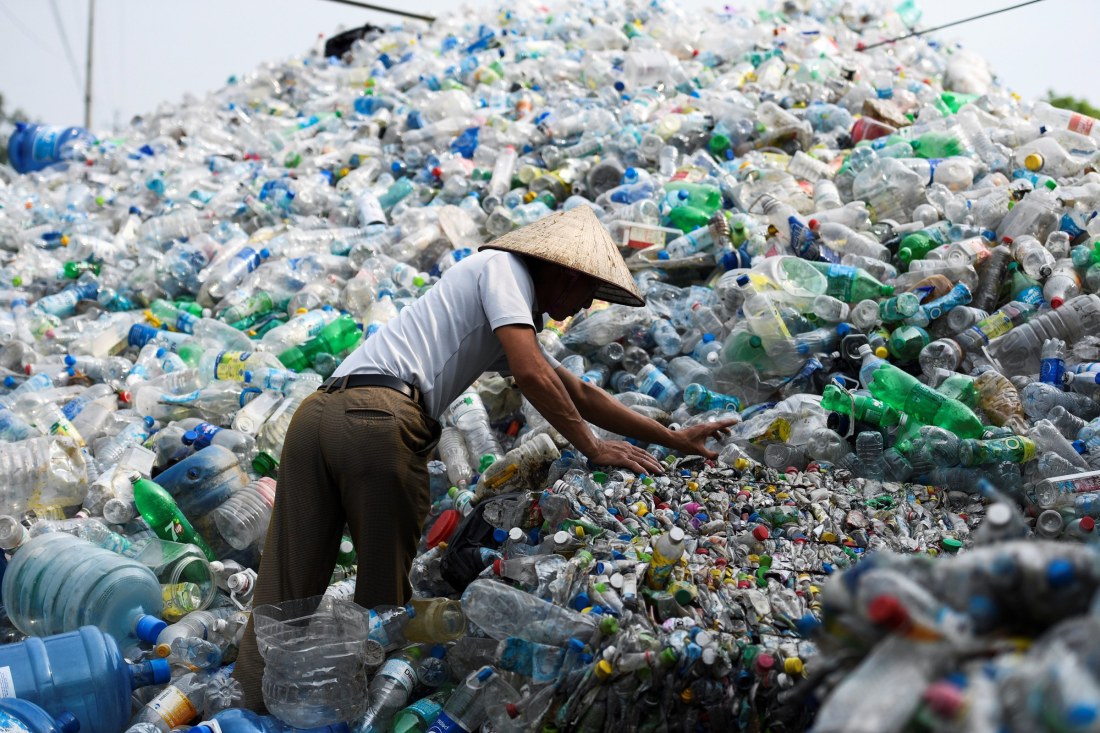
Sorting Waste in Vietnam

Sorting Trash in Vietnam: Photo: NHAC NGUYEN/AFP/GETTY IMAGES

Look a little farther below the surface, however, and you can find another cause. The American consumer. Not the answer in most press coverage? Let’s look at why China, or really anyplace for that matter, would accept the waste from other countries. As noted earlier in this piece, it’s never really been a great business. Economics have been marginal. What it’s really been about is China’s trade surplus. For decades China has been exporting goods the rest of the world wants, and running up huge surpluses, with consequent political pressure from many places to find something to import in exchange. For a while, the biggest something (after raw materials, of course) was trash. It’s probably no coincidence that the decision to curb these imports comes in a period of declining political relations with the US, especially around the issue of trade. On the other side, American consumers continue to consume more, and discard greater volumes. The cost of finding ways to dispose of America’s trash has been partly subsidized by China’s willingness to take it at low cost. We can see this even more from the fact that even before China’s ban, only 9 percent of discarded plastic in the US was being recycled, while 12 percent was burned. The rest was buried in landfills or simply dumped and left to wash into rivers and oceans.

What’s next? No easy answers, and maybe a silver lining for the waste management industry.

The big impact is on consumers, and it is just beginning to be felt. So far the cost is mostly in terms of environmental concerns, with advocates of more recycling instead seeing a decline. In some cases – particularly in smaller towns and rural areas, cost is appearing in terms of convenience: people are either having to drive farther, and/or having to do more pre-sorting of their disposable items. Over the previous decade, single-stream recycling (where all recyclable items are picked up in an office or at curbside in a single container) went from being used in about 30% of US communities to about 80%; this single stream model provides great convenience for users, but increases both contamination levels and sorting costs. Expect single-stream recycling to drop sharply. Some hard-to-recycle though convenient items are being restricted. In Europe, the European Parliament has banned the use of single-use plastics, such as plastic cutlery; Starbucks has taken a similar approach; plastic shopping bags also face more restrictions.

The impact of the great recycling crash is also only beginning to translate into economic costs for consumers. Some of that cost is arriving pre-consumer, as with environmental levies being instituted on plastics in Norway and the UK. More visibly, it is appearing post-consumer, as landfill stations and recycling companies raise their charges to consumers and to municipalities. In places like Berkshire County, in Massachusetts, the municipalities pass those costs onto consumers through higher fees and increased bag prices at transfer stations. This increase in costs is just beginning. The recycling crash is arriving as more waste is being created than ever. According to City Lab (see graphic below), the amount municipal solid waste in the US has grown an astonishing 5-fold since 1985. As Cheryl Katz noted in Wired’s review of recycling, “The United States still has a fair amount of landfill space left, but it’s getting expensive to ship waste hundreds of miles to those landfills. Some of these costs are already being passed on to consumers, but most haven’t—yet.”
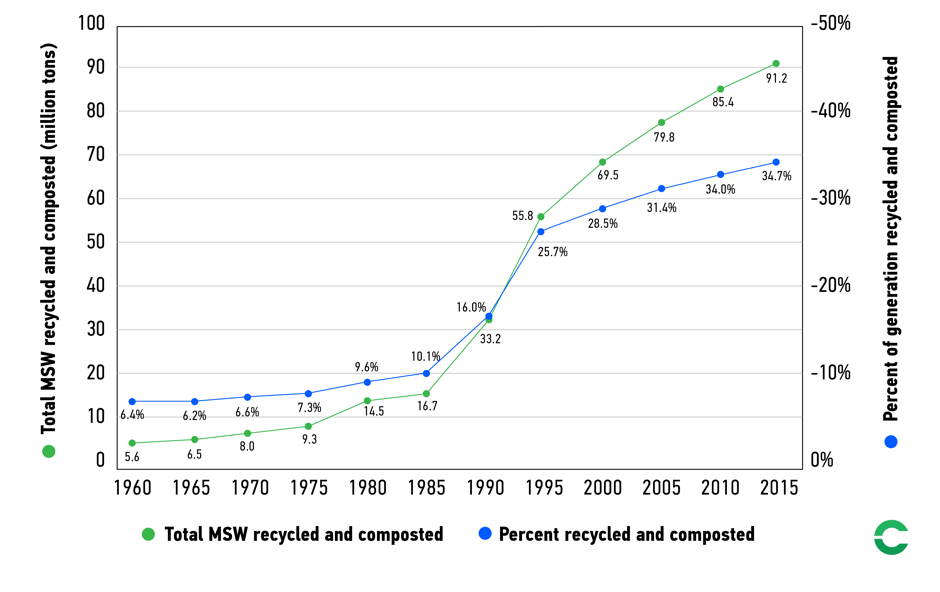
MSW in US over time

Courtesy: City Lab, “China’s National Sword Policy”, Nicole Javorsky

What’s bad news for consumers and cities, having to pay more to manage waste, may be good news – more revenues — for the waste management business. Decades of reliance on China’s de-facto subsidized handling of global waste has meant little money being available for waste management infrastructure in Europe and the US. In general, trash hauling and landfills have been more profitable, and recycling a money losing segment for the same firms. Now more items are going to landfill rather than recycling, which will improve margins for waste managers. Higher recycling fees may help also, although these are offset to a large degree by higher costs. And this increase in revenues means private waste managers are more likely to find the capital needed to build more of the waste management infrastructure needed to address the current crisis.

Some of this new capital investment is becoming visible. Several paper mills in Canada and the US have announced new capacity to process recycled paper. Material recovery facilities are expanding capacity and operations. Some, like Oakland-based California Waste Solutions, are upgrading processes to improve the acceptability of materials to buyers, including in China and other Asian markets. Even some Chinese-based processors, now without raw materials after China’s new standards came into force, are building new plants in the US.

In the longer term, waste management is likely to become a more organized and a more dispersed activity. Instead of most waste going to a single market at de-facto subsidized costs, and sector revenues being insufficient for investment in better sorting, transport, and re-use facilities, we’re likely to see a world closer to equilibrium: revenues in line with the cost of building and operating recycling facilities, and both processors and end-buyers well-spread geographically, with transport costs curbing distances over which waste is transported. It will be more expensive and less convenient for consumers, which in turn may (one crosses one’s fingers) lead to the generation of less waste. It’s a silver lining. Of course right now, it’s a mess.
Asia’s Energy Transformation: Indonesia

On April 17, voters in Indonesia went to the polls and apparently re-elected President Joko Widodo (“Jokowi”) to a second term. Final results are due May 22. This election, and President Jokowi’s second term, if early results are confirmed, will have momentous consequences for infrastructure, energy and global climate.

This is the third in an Infrastructure Ideas series on the state of Asia’s Energy Transformation, following earlier reviews of the energy situation in Pakistan and in Bangladesh. Indonesia shares many commonalities with the other two countries: one of the ten most populated countries in the world (with over a quarter of a million people, Indonesia has the 4th largest population), facing energy high demand growth while running out of domestic fuel sources on which it has relied, and strongly considering a large-scale expansion in its coal-burning capacity to meet its energy needs. The energy choices Indonesia makes in the next few years will have major effects on the availability and cost of energy for Indonesians, and on global climate.

President Jokowi’s initial election, in 2014, was widely greeted as great news for infrastructure in Indonesia. His electoral platform stressed implementing reform programs needed to address Indonesia’s widespread and longstanding infrastructure problems, including beginning to bring in private capital and reduce reliance on Indonesia’s state-owned monopolies. His first term did not live up to expectations on this score: government bureaucracies and vested interests have been largely successful in limiting change. Yet needs continue to grow, and the same problems and choices will now face a second Jokowi administration.

Energy is the most critical battleground between the Indonesian old guard, clearly proponents of both maintaining state control and relying on Indonesia’s coal resources to meet energy needs, and reformers. Indonesia’s current electricity consumption and production are very low for a country of its size, with production capacity of about 60 Gigawatts (GW), slightly over half of which is coal based. The country’s “Electricity Supply Business Plan” (Known as RUPTL) calls for a near-doubling of capacity, to 115 GW by 2025, including from 25 to 35 GW of new coal-fired capacity. This places Indonesia among the five countries with the largest plans for new coal-fired power.

Indonesia’s coal resources are large, and unlike Pakistan and Bangladesh, the country has been developing and exploiting these at a large scale for decades. Indonesia ranks as the fifth largest coal producer globally (After China, the US, Australia and India), and is the world’s second biggest exporter of coal, after Australia. Those resources, however, are not unlimited: Price Waterhouse Coopers forecast that at planned utilization levels, the country’s coal resources would be exhausted by 2033.

Indonesia’s domestic energy resources are not at all limited to coal. The country was an oil exporter, until falling oil production turned into an importer. It has widespread hydropower potential, albeit complicated by land ownership and biodiversity considerations, and among the best geothermal energy potential of any country. About 9 GW of total electricity capacity today is renewable energy, mostly hydropower. The latest RUPTL projected a 300% increase in renewable energy capacity by 2025, to about 35 GW: 6 new GW of geothermal, 12 GW of large-scale Hydropower, and 8 GW of wind and solar (mostly wind). However, development of renewable energy has been largely stalled, due to a combination of land/biodiversity issues affecting hydro and geothermal projects, and of inability to get wind and solar-based power production off the ground. As a result, unlike many countries which are rapidly ramping up the share of energy use based on renewables – largely because these have become the cheapest alternatives, Indonesia has been stuck: not moving forward, and trying to do so mostly with coal-fired megaprojects. President Jokowi’s legacy in Indonesia will be largely determined whether in his second term he succeeds in getting the power sector unstuck, and in moving the country into exploiting low-cost wind and solar electricity, or whether he remains mired in Indonesia’s bureaucracy and vested interests.

Part of the roadblocks to Indonesia’s development of renewable resources is complicated: the land and biodiversity issues which are involved in many potential large-scale hydropower or geothermal projects will not easily be solved. But another part is simpler: country after country is taking advantage of the combination of free-falling technology costs in wind and solar and of auction mechanisms which force competition among the world’s still-growing number of producing companies. IRENA has stated that Indonesia has 47 GW of solar power potential. At least, better said, technically simple. And economically simple. The officially estimated cost of greenfield coal-fired generation may be lower in Indonesia than anywhere else ($0.05/ kilowatt hour), but those estimates like in many other places underestimate both coal transport costs and the impact of current disruptions in the coal market, without pricing in likely medium-term scarcity costs. Wind and solar prices are already on a par with the low-end of coal-based generation prices, and continue to fall.

Where large-scale development of wind and solar electricity in Indonesia is not simple is in the politics. The state-run power utility, PLN, combines a monopoly of transmission and distribution with being the by far largest producer of power. It is an artefact in a world where most countries have separated power generation from T&D responsibilities, and where most have increasingly turned to private capital for financing new generation capacity. And as both a competitor and the eventual buyer of wind and solar power from potential new producers, its enthusiasm for the wind and solar auctions which have triggered rapid growth in renewable capacity in many countries has been superficial. PLN would far rather build power plants itself – which means thermal or possibly hydropower power – than have others build them. Its reasons are a mix of classic bureaucratic inertia and self-interest, and of links to political interests and corruption. The reasons are not economic: the government has pumped between $3 and $4 billion annually into PLN in recent years to cover losses, and letting others finance power which will come at a lower cost to PLN would reduce those losses. A recent documentary released in Indonesia, which the government has tried hard to suppress, is named “Sexy Killers,” and highlights the links between the country’s coal industry, PLN and politicians. And as noted in a recent column by Bill McKibben, the potential for bribes in small-scale, decentralized wind and solar development is far smaller than it is where single mega-projects such as coal plants involved.

The past few months have seen somewhat of a stalemate. A few renewable projects have inched forward, as have a handful of natural gas-fired projects. But large-scale auctions for wind and solar have made no progress. The 2019 RUPTL, released in March, gave more verbal support to wind and hydropower, though without indicating it would take practical steps to bringing this closer to reality. A number of coal-fired plants planned in Java were reportedly suspended or cancelled, yet have re-appeared in the new policy document, and plans for solar are minimal. As noted in its review of the RUPTL, IEEFA called the statements about incorporating more renewables “a cut-and-paste planning exercise that does little to address fundamental problems with Indonesia’s over-reliance on coal-fired generation,” and stated that “Indonesia appears to have embraced what can best be described as a contrarian understanding of power trends with the decision to add less than 1 GW of solar over the next decade.”

On April 23, the arrest was announced of PLN’s CEO, Sofyan Basir, on charges of corruption related to a $900m coal-fired power plant. Unlike in the case of competitive public auctions in wind and solar, this coal project – Riau I – was awarded directly by a PLN subsidiary to a Singaporean company (arrests include one of the Singaporean company’s Board members). A sign of the tide turning? Indonesia’s energy and economic future hangs on the decisions that will be made by President Jokowi in his second term. As does a lot of carbon.

$3 billion for Mobility in the Middle East

In June 2018, Infrastructure Ideas surveyed the mobility revolution in transport. It was clear that capital was soon going to be flowing here in amounts rivaling traditional transport sectors such as ports, airports and railways. And while 95% of the capital to date in these sectors was being deployed in OECD countries, we predicted that soon, as in most areas of infrastructure, the majority of new capital would be seeking out higher growth opportunities in Emerging Markets. It didn’t take long to check that prediction.

Last week, Uber announced that it would acquire the Middle East’s largest ride-sharing service, Careem, for over $3 billion.

This will be one of the largest private infrastructure transactions to date in the Middle East. And for a company that is barely six years old. Careem, based in Dubai and operating across fifteen countries in the Middle East and surrounding areas, was founded in 2012. Ride-sharing was not even its initial business, as it was founded as a corporate car service, before following consumer demand into ride-sharing and delivery services similar to Uber Eats. Large markets served by Careem include Pakistan and Turkey.

For Uber, this is not only big money, but a departure from how it has addressed its Emerging Market competition to date. In China, in Indonesia, and in Russia, Uber has previously chosen to sell its in-country operations to local rivals, preferring to raise cash to cover losses, rather than maintaining loss-making operations in more countries. The Careem acquisition signals that as it edges closer to breaking even and to profitability, Uber may now be more willing to pay for control of Emerging Market rivals. Uber is initially signaling that Uber and Careem services will run in parallel in the dozen or so countries where the two both operate. CEO Mudassir Sheikha will continue to run Careem, according to Uber’s announcement. China’s Didi Chuxing, the biggest ride-sharing company in China, has been one of Careem’s largest investors. Careem’s previous fund-raisings had generated some $800 million, and analysts place Uber’s acquisition price at about a 50% premium to previous valuations.

The announcement follows by days the IPO by Lyft, which valued Lyft at $22 billion. Uber’s preparations for an IPO have been widely covered, with an expected valuation of around $120 billion.

This is another sign of how technology, after revolutionizing the energy business, is having a larger and larger effect on other parts of the infrastructure world. As we’ve previously written, for investors, staying locked into traditional segments and failing to understanding the impacts of technology will carry a high cost in missed opportunities.

Asia’s Energy Transformation: Bangladesh

Asia’s Energy Transformation: Bangladesh

This is the second in an Infrastructure Ideas series looking at the way energy use is changing in Asia’s major economies, and the momentous choices facing policy-makers there today. Following the previous post covering Pakistan, this post features the world’s 8th most-populous nation – and the country with one of the five biggest project pipelines for new coal-fired generation: Bangladesh.

Bangladesh, known as East Pakistan from 1949 to 1972, is the most densely populated country in the world. Its energy profile has many similarities with that of Pakistan: both countries have enjoyed significant domestic natural gas resources, which played a major role in the development of the countries’ power grids – Bangladesh’s even more than Pakistan’s. Both Pakistan and Bangladesh are relatively low-income, and have among the lowest per capita levels of energy consumption in the world, and among the highest aspirational rates of growth for future energy consumption (Bangladesh’s growth rate has been in the 6-7% per annum range). Both countries subsidized consumption of domestic natural gas resources by keeping prices well below those prevailing internationally, and in part as a result reserves have been in decline and the ability to keep supplying gas-fired power plants is now in question. Both countries have largely untapped domestic coal reserves, generally of low quality, and coal enjoys a major role in future energy planning in both. Bangladesh and Pakistan are also late-comers to renewable energy (leaving aside Pakistan’s large hydropower capacity), with Pakistan having turned somewhat earlier to initial wind and solar power auctions.

Critically, both countries face a similar fork in their energy roads: build substantial new coal-fired electricity generation capacity – potentially making them among the 3 or 4 largest builders of new coal plants in the world – or encourage large-scale development of wind and solar power. The policy choices these two countries make will have major implications for their economies and people, as well as for global climate.

Thinking about growth is essential for understanding Bangladesh’s energy choices. The country’s total power generation capacity in 2015 was only 10 Gigawatts: more than 40 countries produce more electricity than this, while only 7 have more people than Bangladesh. And this is after roughly doubling Bangladesh’s capacity in the last decade. Bangladesh’s energy policy calls for raising power capacity by 2030 to 30 Gigawatts – triple the amount of electricity produced today. That’s growth! Bangladesh needs this much power, both to make up for its very low current consumption, and to support the high growth rate of its economy.

The issue for the country is that its current sources of energy cannot keep up with existing capacity, let alone this projected tripling. Today three-quarters of electricity in Bangladesh is supplied by natural gas, and Bangladesh is running out of it. Reserves are projected to be exhausted somewhere around 2029. Taking advantage of the changes in the natural gas industry – which in the last decade have made it an internationally traded commodity – Bangladesh has begun to invest in import terminals to bring external natural gas into the country. This makes plenty of sense as policy. However, the new imported gas is likely to be needed entirely to substitute for declining domestic gas sources, and is unlikely to be a major source of new capacity. Concerned as well as it is by today’s over-reliance on gas, Bangladesh’s government has focused on diversifying energy sources, which again makes sense. The question is how best to do this.

The Government of Bangladesh’s stated energy plans have for years focused on one principal answer: develop coal. While coal produces less than 500 MW of electricity in Bangladesh today, government projections have shown 2030 capacity as high as 20 Gigawatts – essentially all the planned increase in electricity production for the country. A 20 Gigawatt coal-fired pipeline would place Bangladesh – which is not in the 40 largest power producers today – 5th in the world in new coal-fired capacity: after only China, India, Vietnam and Indonesia. Bangladesh also has an important friend ready to support this policy choice: China. Bangladesh is a country of focus for China’s Belt and Road Initiative, and for Chinese financing generally. IEEFA has reported that Bangladesh has the most proposed coal-fired capacity and funding offered from China of any other country, totaling $7 billion for 14 Gigawatt of capacity (somewhere between 1/3 and ½ of total estimated costs for these projects).

Aside from China, support for coal-fired development draws from two other major sources: one, an outdated sense of economics, and two, perceived greater profitability. Bangladesh has been worrying about running out of natural gas and needing new energy sources for over a decade; during most of this time, coal has been accepted as the lowest-cost alternative, and still today many planners and onlookers think of it that way. Given the historical subsidy for domestic gas, electricity has been relatively cheap for Bangladeshis, and politicians are wary of new capacity forcing a sharp increase in prices. This sense of coal’s cheapness has fallen out of tune with today’s realities, but opinions have been slow to adapt. Coal-fired plants are also, universally, very large projects. Very large projects also, universally, give the greatest opportunities for large profits – regrettably often of the corrupt kind: it is much easier to get rich skimming off a mega-project than from dozens of small-to-mid-size renewable projects. Coal-based electricity also means large-scale domestic coal mining, with similar opportunities.

The big drawback for a coal-based plan for Bangladesh is economic reality. The perception of coal’s cheapness does not match its real costs (and here we only mean economic cost, without speaking of externalities like emissions). Developing Bangladesh’s coal mines will be very expensive, and very large greenfield projects also come with very large risks of delays and cost overruns. Transporting the coal to power plants can also be expensive. Importing coal also has high transport costs, as Bangladesh has virtually none of the needed import infrastructure it would require to feed several coal-fired plants. So coal feedstock is not likely to prove very cheap. A best case, looking costs in neighboring India, is that Bangladesh would produce coal-fired electricity at $0.08/ kilowatt hour – about the average retail price for electricity in the country today. More likely, with all the required ancillary infrastructure, large-scale coal power would cost at least $0.10/ kilowatt hour.

By contrast, auctions almost everywhere for wind and solar power are seeing prices at $0.07/kilowatt hour – even at $0.03/kilowatt hour in a handful of countries. Prices for generation continue to drop. Prices for energy storage, required to make intermittent wind and solar power available around-the-clock, are also dropping fast. The economics of wind and solar will increasingly be better than those of large-scale coal.

The problem for Bangladesh and its policy-makers today is that successful auctions for large-scale wind or solar power require significant planning. Planning is required not only for the new generation plants, but also for associated storage, and for upgrading the transmission grid to deal with large amounts of intermittent power supply. The planning is made trickier due to the lack of available land in Bangladesh, unlike in Pakistan. While Bangladesh has some excellent people resources in its ministries and administration, it doesn’t have a great many of them. One dead-end answer being looked at has been to have the government be the one to build solar plants: this has not worked anywhere outside China (excluding China, wind and solar generation is nearly 100% privately owned), including countries with much more public execution capacity than Bangladesh.
Still, this looks like a better set of problems to have to solve than those associated with coal.

These are big decisions for Bangladesh. Get it wrong and power prices will go up, with attendant political risks. Do nothing, and the economy will strangle for lack of power. Do coal, and the climate equation for everyone gets worse.

Lately, there are positive signs that Bangladesh is making the needed course correction. The Bangladesh Power Development Board’s 2016 Annual Report noted an expected eleven new coal-fired plants to be commissioned in the next five years. Its 2018 Report has this down to three, of which one – the Rampal project – has already seen repeated delays. Gas-fired projects are moving forward closer to the expected rate, with the GE and Mitsubishi joint venture with Bangladesh’s Summit Group – signed in July 2018 to establish five power plants along with gas import facilities – slated to become the country’s largest private investment on record. But wind and solar will be needed to fill the gap and help Bangladesh keep up with growth. Another country to watch for big decisions.

Asia’s Energy Transition: Pakistan

Asia’s Energy Transition: Pakistan

This is the first of a series on the energy transition in Asia’s largest economies. Asia is the most important global market for energy consumption, investment, and greenhouse-gas emissions. Asia is also a region in the midst of a large-scale energy transition, whose pattern and evolution remains to be determined. How this energy transition evolves has more importance to the future of climate change, and to the future of energy investments, than that of any other region. Infrastructure Ideas will focus in turn on the state-of-play in this transition in several of Asia’s big economies, starting with Pakistan.

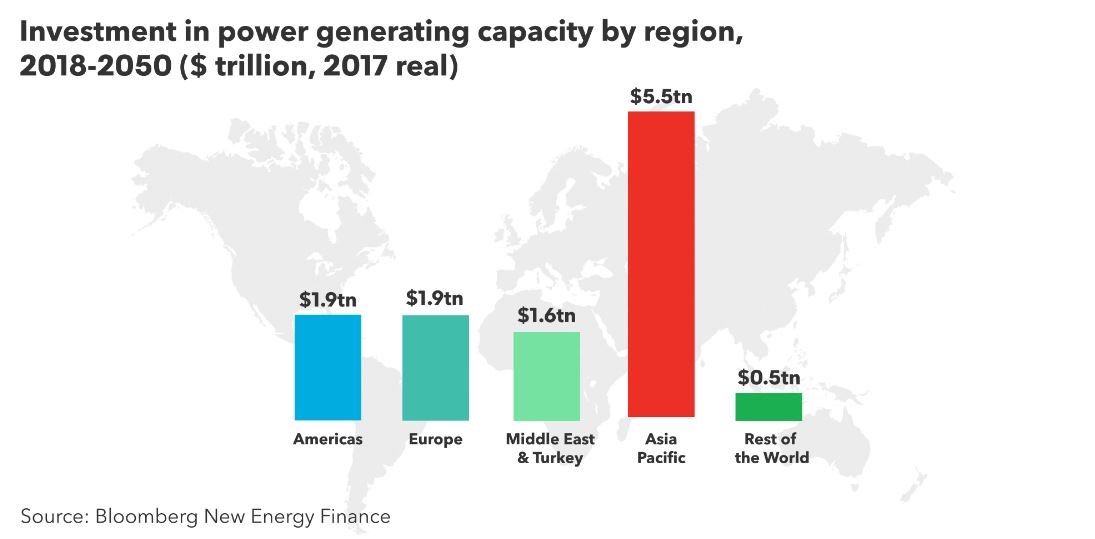
A few numbers illustrate the importance of Asia in the energy world. Between economic growth and connecting the underserved (just under 500 million of the 1 million people without access to reliable electricity are in Asia), the region dwarfs all others in expected energy consumption growth. Bloomberg New Energy Finance projects that, in Asia, over $5 trillion will be invested in power generation capacity from now to 2050, over $180 billion per annum. Asia is expected to account for nearly 50% of all such investment globally.

Power investments by region to 2050
Asia-Pacific also accounts now for about half of all Greenhouse Gas emissions, and in line with growing energy consumption, the growth rate of emissions from Asia, at over 3% p.a., is triple the growth rate of emissions of the rest of the world. Behind this high share of GHG emissions is not only overall energy consumption growth, but more importantly how much of electricity production in Asia is coal-fired. 67% of all coal-fired generation capacity is in Asia, and essentially all of the growth in new coal-fired capacity globally is in Asia. So as well-reported, Asia is the key battleground for future GHG emissions evolution, and for the scope of future climate change. How decisions are made about more coal, less coal, and the speed of adoption of renewable energy sources will have a disproportionate effect on the rest of the world and future generations.

Pakistan is a key player in Asia’s energy transition, albeit one drawing far less attention than China and India. This is somewhat surprising, given that Pakistan is the world’s 6th most populous country, with about 200 million people. Pakistan also has plans for larger investment levels in new power capacity than all but a handful of countries, and some plans to increase coal-fired electricity production by over 500%… so an important country on many fronts! Let’s look more closely at the state of play.

For a country with as many people as Pakistan, and which has recorded solid economic growth for decades, power production is remarkably low. Total generation capacity today in the country is only just over 25 Gigawatts (GWs), and per capita electricity consumption is only 2/3 of that in India, and only 1/3 of that in Egypt. While 90 million people have gained access to formal electricity over the last two decades, there are still some 50 million people without access, and industry is hampered by extensive load-shedding, often over 10 hours a day. Thus increasing power availability has been a high government priority in Pakistan for a long time, and one can expect that the country will add substantial new production capacity over the next couple of decades.

Pakistan’s power sector is of high importance – for provision of basic services, supporting economic and job growth, and for public finances. It also has some oddities. One is the unusually high share of oil-fired generation: about 1/3 of Pakistan’s electricity is produced from either diesel or fuel oil, probably the highest ratio – by far – of any of the world’s largest countries. This has had and continues to have major negative consequences in terms of higher costs, high GHG and particulate emissions, and large trade deficits (Pakistan imports most of its oil). Hydropower and natural gas-fired generation each account for just under 30% of production, coal about 5% and nuclear a little less. Another oddity (shared with a small handful of its Asian neighbors) is the high percentage of power production which is government-run, at about 50%. A 2018 World Bank Report (“In the Dark”, World Bank 2018) estimated that these public sector plants use 17-28% more fuel per output than their private sector counterparts, and that mostly public policy and management inefficiencies in electricity cost the country 6.5% of GDP annually.

In the last five years, Pakistan has entered into a new energy transition, whose direction and outcomes remain very uncertain. The key energy policy decisions going forward for Pakistan revolve around its current transition, and the 20-30 GW of new electricity production capacity it seeks to add.

It has been clear to the Government that continued reliance on oil-fired generation is financially impossible. Yet between the choices of coal, gas, hydropower, wind and solar, the right direction has not been obvious. Development of more coal-fired capacity has had many supporters in Pakistan: the country has large domestic coal resources, coal has historically been a cheap source of fuel, and some government plans have called for coal to assume an up to 30% share of electricity production – compared to about 5% today. Domestic natural gas became important in the decades after independence, but domestic fields are essentially exhausted, and new imports of gas – while important – are at best replacing previous domestic sources, and are in part diverted to domestic fertilizer production. So the share of gas-fired power production is likely to decline substantially. Hydropower may be an important part of the solution. Pakistan has important developed and undeveloped hydropower potential. In the early decades after independence, large-scale dams were constructed by the country’s public sector utility: its chronic losses and mismanagement have essentially made further investment out of the question. Pakistan has instead turned to auctions, whose winners have to date been dominated by Chinese firms, notably China Three Gorges. This holds some promise of relatively low cost and low emission capacity growth, but contentious water ownership issues close to the border with India, climate-change related hydrological uncertainties, and the sheer scale of the new plants likely limit how big a role they play in overall country capacity growth. This leaves the key uncertainties of the transition between large-scale coal-fired generation increases, and accelerated development of wind and solar resources.

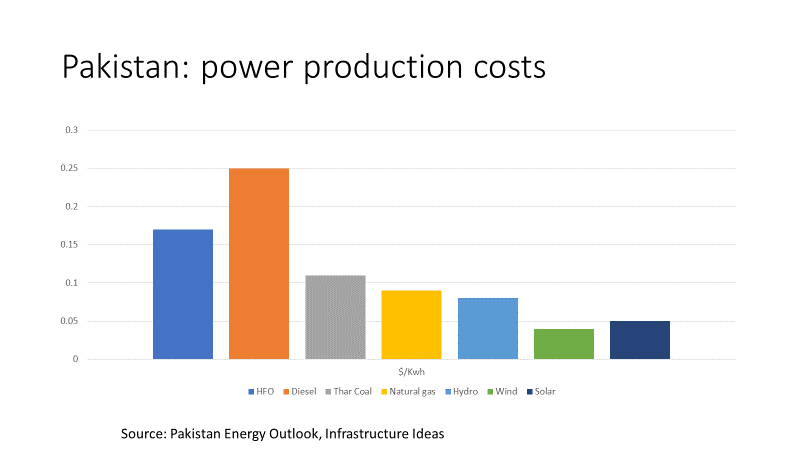
While not an early adopter, Pakistan has begun to replicate the renewable energy auction procurement mechanisms which have so strongly impacted many emerging markets. Roughly 40 new wind and solar farms have been provided PPAs, and at prices (US$0.05-0.07) well below Pakistan’s average power costs.

Pakistan power costsOn the one hand, renewable energy is now the cheapest form of electricity generation in Pakistan. This should not be unexpected, given how falling costs have made wind and solar the cheapest options for new capacity in much of the world – accounting for over 50% of all new electricity capacity additions worldwide in 2017 – and Pakistan’s plentiful wind and solar resources. On the other hand, renewable energy proponents carry limited political weight in Pakistan. Proponents of expanded use of coal, by contrast, carry substantial weight – both domestic supporters who would like to see investment in local coal deposits such as the massive Thar field, and external financiers looking to sell coal and coal-fired generation plants – mainly from China. The Chief Minister of Sindh Province, where many of the country’s coal deposits lie, stated in early March that the long-delayed Thar coal-fired plant would “start soon.” Given Pakistan’s long-unstable domestic politics, and perennial foreign-exchange problems, the verdict on the country’s energy transition remains out. The implications are significant – building another 15-20 GW of coal-fired generation in Pakistan in the coming decades could add up to 100 million tons to annual CO2 emissions – an increase of 40% over Pakistan’s current CO2 emissions, and roughly what 25 million cars produce. And, given the contrary trends in prices, probably leave system-wide power costs at least 20% higher than they could be. This is clearly a country whose energy politics bear watching.

Some positive signs? In January, the 1,320 MW, the proposed Rahim Yar Khan imported coal-fired power plant was shelved, reportedly over concerns about increased fossil fuel imports. And in February, during a State visit, Saudi Arabia’s ACWA power, one of the largest wind and solar generation companies globally, was quoted as seeing the potential for up to $4 billion in investment in renewables in Pakistan.

Populism Trumps Infrastructure Solutions (again)

Populism Trumps Infrastructure Solutions (again)

Yes, this is a piece about a country in the Americas, and about a populist President, and about an unexpected snap decision which throws out something completely practical and useful, and about how politics can really screw up the delivery of infrastructure services.

No, it’s not about the US.

On February 4, Mexico’s new President, Andres Manuel Lopez-Obrador (AMLO for short), announced the cancellation of what would have been Mexico’s fourth long-term electricity auction.

From a practical point of view, this decision makes zero sense. Mexico has been struggling for several years with the difficult cocktail of slow economic growth, not enough jobs for a growing population, violence coming in part from insufficient legitimate economic opportunities, and widespread corruption coming in part from large, inefficient and politicized public companies – notably PEMEX and CFE — the government-owned oil and electricity companies. Underlying the economic slowdown has been the price of energy in Mexico: thanks to the dramatic drop in oil and (especially) natural gas prices across the border in the United States, Mexico’s cheaper labor costs ceased being a big advantage for manufacturing firms. Cheap labor relative to the US was now offset by expensive energy. The Maquila sector, the manufacturing firms set up in Mexico’s north to sell to the large US market, went from high growth to no growth. Over the last six years, bringing down Mexico’s energy’s costs, and so restoring Mexico’s cost advantages, has been a top national priority.

Mexico’s greatest success over the last few years, arguably, has been the beginning of delivery on its low energy cost strategy. Some aspects, notably cheaper domestic gas and better natural gas transport, has moved slowly. But in buying cheaper electricity, Mexico has enjoyed spectacular success. Building from a base of highly efficient wind farms installed in the last decade, Mexico’s solar auctions have delivered commitments from private firms to deliver solar power at some of the lowest costs on the plant. The first auction, in 2015, delivered commitments from large private generating companies for power at just over $0.04 a kilowatt hour, well below average system costs – not just for Mexico, but also for the US. In the third round of auctions, in late 2017, costs fell all the way to $0.02 a kilowatt/hour – or between 1/3 and 1/4 of the cost of most power in Mexico. Or between 15% and 20% of what a US consumer would pay for electricity.

The total amounts of power being purchased under the first auctions was relatively small, with about 3 GW of new solar connected to the Mexican grid at the end of 2018. At about 5% of Mexico’s total power capacity, this is not yet enough to force system-wide costs down and to enable the lower energy costs Mexico needs to regain some its advantages relative to its northern neighbor. To get there, more auctions for more capacity were the clear path. All laid out on a plate for the country’s new President, who could be soon on his way to claiming victory on Mexico’s big economic priority.

But it’s not to be. Saying you’re smarter than your predecessor, and bad-mouthing private providers, have proved more politically appealing than continuing to deliver on an infrastructure that was working, and working amazingly well. AMLO has announced that CFE, the government-run utility, will instead be asked to expand its power generation. In a world where now dozens of countries have achieved spectacular reductions in the cost of new electricity capacity, having a state-run utility in charge of installing low-cost solar and wind plants has worked… nowhere.

A sad day for Mexico. And a reminder that the biggest obstacle to infrastructure improvements for many governments is – the government itself.

EV Buses: the next big thing (maybe)

EV Buses: the next big thing (maybe)

Over the last two years, electric buses emerged as “the next big thing” in infrastructure for cities around the world. As noted by Infrastructure Ideas last year (“Notes from the Revolution: implications for infrastructure investors”), the market for electric buses has been developing even faster than the much-publicized market for electric cars. McKinsey calls this “the most successful electric vehicle segment,” with a 5-year sales growth rate of over 100%. Bloomberg New Energy Finance forecast, due to EV buses’ advantages in operating and maintenance costs and concerns over urban air quality in many mega-cities, that electric buses will capture as much as 84% of the new bus sales market as early as 2030. The European Commission has called for 75% of all buses to be electric by 2030.

For those readers who don’t ride buses, especially those in North America where e-buses are barely beginning to be introduced, this might look like a quaint but largely irrelevant sideshow. Yet this is already be a $50 billion dollar a year infrastructure market, and global investments in electric buses will likely be well over $1 trillion through the end of 2030. Not a market to sneeze at.

Yet as 2019 gets going, the prospects for EV have gotten cloudier. A lot of advantages and enthusiasm remains, but the experience of early adopting cities has also raised concerns to be addressed. Let’s see what is happening.

Over 100,000 electric buses were sold in 2018, costing between $300,000-$1 million each. Of those, over 85% were sold in China, which has a huge lead over the rest of the world in adoption and production to date. So the experience in China is by the far the deepest. But let’s begin with the more limited European and North American experience.

The experience to date with EV buses in the USA and Europe was summed up recently by City Lab’s Alon Levy in his column “The Verdict’s Still out on Electric Buses.”  EV buses have been shown to struggle when it’s too hot, too cold, or too hilly. Much of the issue has related to charging range, with for example Albuquerque finding that their new fleet – purchased from Chinese market-leader BYD – is showing a range of about 2/3 the contractually indicated range of 275 miles per charge. Most of the buses there ran on the city’s Central Avenue route, which features a large elevation change – consistent with the experience of Hong Kong, which also found that EV buses struggled on the hills there. Albuquerque has reportedly returned their buses to BYD. Phoenix, also in the Southwest, reported issues when temperatures hit Summer peaks over 100 Fahrenheit. Meanwhile cities in Minnesota and Massachusetts have found that EV bus charging range drops off significantly when temperatures drop to freezing or below. In Moscow, where Mayor Sergey Sobyanin has made a big push for electric buses, early experience indicates that roughly double the number of buses anticipated have been needed on routes run with EV buses, due to higher than planned time required to charge the buses.

If performance is problematic, and translates into higher – as opposed to lower – operating costs, this burgeoning new market may be in trouble. After all, like with other electric vehicles, EV buses still cost more to purchase than traditional diesel buses – up to 30% more. Notes of caution, as a result, are becoming more common across transit agencies.

China, as noted, now has much more experience with EV buses than North America – in fact, more experience than the rest of the world combined. How has this gone? The answer: much better, but to some extent the verdict is also still out.

Chinese cities such as Shanghai and Shenzhen have become world leaders in electric mass transit. A recent profile of the Shenzhen experience – where all 16,000 buses are now EVs — in The Guardian (“Shenzhen’s Silent Revolution: the world’s first all-electric bus fleet”) was extremely positive. Service levels have been satisfactory, annual CO2 emissions have been cut by nearly a million tons, air pollutants cut as well, and fuel expenses slashed. Because of the volume of the market, EV buses cost less than half (about $300,000) than they do in the US. Which still implies that Shenzhen has bought about $5 billion worth of buses. In the next two years, another 30 Chinese cities plan to achieve 100% electrified public transit, including Guangzhou and Nanjing. Yet a big piece of the success has been on the back of public subsidies. These subsidies make all sorts of sense in terms of public interest in China, with air pollution having been a major health and policy concern in many Chinese cities for years. But they are large – reportedly at around 50% of the capital cost of a bus, plus some operating cost support. These subsidies are due to lapse after 2020, so it will be interesting to see how the domestic market evolves subsequently. Investment in charging stations has also been substantial, with Shenzhen building around 40,000 charging points. And, as elsewhere, hilly terrain (Hong Kong) and cold (northern China) have negatively affected EV bus performance.

What to make of all this? EV buses, like most other disruptive technologies, will take some time to shake out issues. And the issues are real. Yet, it’s easy to forget that the early generations of wind turbines and solar farms failed to meet performance expectations, and experienced various teething problems. These problems haven’t prevented wind and solar from accounting for the vast majority of new electric capacity additions. And both charging technology and bus batteries are still evolving rapidly, with costs continuing to fall and capabilities improving. Perhaps some jurisdictions will decide that unusual conditions – cold, heat, or terrain – should make them late adopters, or hold-outs on EV buses altogether. And many cities will exercise some more caution in planning and procuring their next generation of public transit capacity, which is a good thing. In many Emerging Market cities, with substantial numbers of informal buses plying routes, transitions will take a lot of effort to manage. And it will take a lot of money, which cities will need to finance.

But in the end, EV buses are a superior technology, with rapidly declining costs, and that will be the determinant of the market. Cities will only face more demand for better air quality. Charging costs are far lower than diesel fuel costs. Technology advances and larger manufacturing scale will turn the current upfront cost disadvantage of EV buses into a large cost advantage over the coming decade. “Range anxiety” will find solutions, in improvements of both battery technology and convenience of charging. As for the reliance on subsidies, this is of course an important issue. Yet again the parallel with solar power generation is instructive: subsidies in early years raised production volumes, and accelerated the technology-driven decline in costs. In 2012/2013, for instance, an observer of solar power would have seen something similar to the EV bus market: an apparent reliance on subsidies driving volume, especially in China, and a 20-30% cost disadvantage over alternative technologies. Five years of cost declines later, the cost disadvantage has become a large cost advantage, and subsidies irrelevant. Hard to find reasons that the same story won’t play out with EV buses.

For cities, and for investors, a note of caution on EV buses is fine. Ignoring the coming of a $1 trillion market would be an expensive mistake. Not all cities will spend $5 billion on bus fleets like Shenzhen, but there an awful lot of big cities in the world. This will be a capital-intensive transition. Stay informed and up to date. The diesel bus is heading in the direction of the coal-fired power plant.

The PG&E Bankruptcy: Five Questions

The PG&E Bankruptcy: Five Questions

Earlier this week, on Tuesday January 29, Pacific Gas and Electric Corporation (generally known as PG&E) filed for bankruptcy in the Northern District Court of California. Headline news in all the financial press.

PG&E, which serves northern California, has the largest number of customers of any utility in the United States. The filing noted that PG&E had assets of $71 billion, against liabilities of $51 billion, but was facing an estimated up to $30 billion in further liabilities as a result of the major wildfires which have swept through California in the past two years. That number could wind up significantly higher, as PG&E faces possible liabilities in as many as 17 of California’s 21 wildfires from 2017, and an unknown number from 2018 wildfires which caused more losses in lives and property. Insurance cover? About $2 billion. Its stock has lost over $20 billion in value in the last three months.

This is the first bankruptcy of a major utility to be linked to climate change; indeed, it may be the first major corporate climate change-driven bankruptcy across all industries. While it is too early to tell how the bankruptcy will proceed, it is clear there will be major implications. And many warnings and lessons for utilities around the world. In this post, Infrastructure Ideas will look at five big questions arising from this event.

1. Will post-Chapter 11 life return to normal for PG&E? No.

The utility’s reorganization process under Chapter 11 bankruptcy will be complicated. Compensation for those affected by wildfires, estimated at $30 billion, could wind up substantially higher. Electricity rates were already raised in 2017 – to between 11.9 and 29.8 cents per kilowatt hour – in order to address liabilities from wildfires in earlier years, and there seems to be limited room for yet higher tariffs at a time of widespread condemnation of the utility’s performance. The Company is seeking to be released from paying renewable energy providers rates earlier negotiated under Power Purchase Agreements (PPAs): federal regulators ruled against the request, and PG&E is appealing in court. Such a release would complicate operations for wind and solar generators selling power to PG&E, and have widespread ramifications across many geographies. And some California legislators are taking the position that a large, integrated utility like PG&E no longer is appropriate for an age of more decentralized renewable energy production, that its gas and power businesses should be separated and the company split into a number of smaller, more localized utilities.

Whichever outcomes fall out of the bankruptcy and reorganization, one thing is clear. Life for PG&E will never be the same. It was already faced with complex challenges as a buyer of electricity, with on the one hand regulators mandating it to buy a growing share of intermittent renewable energy, and with wind and solar generators on the other hand constituting a much more varied electricity supply base, and with challenges as a buyer and seller of natural gas, where traditional long-term purchase contracts are increasingly a concern in the face of future uncertainty over fossil fuels. Now it also faces a future where the trigger events for its current bankruptcy are expected, unfortunately, to be ever more frequent. As The Economist pointed out in its coverage, with climate warming and extreme events such as severe droughts becoming more common, wildfire costs look set to be the norm in the western US, and many other geographies as well. So what is clear about PG&E’s future is – it’s not PG&E’s past: it is not the life of a stable, low-risk utility with predictable (and easily managed) problems. Rather, PG&E’s future is one of more erratic price risks, greater uncertainty about policy mandates, and recurring uninsurable risks.

2. Will other utilities face similar risks to PG&E? No. And yes.

One aspect of PG&E’s bankruptcy is relatively unique. Its exposure to wildfire-related liabilities is far greater than most utilities, in that its jurisdiction, California, is one of only two US states with strict fire liability for utilities (Alabama is the other). Investors in Southern California Edison may be nervous about a similar scenario, but the other 99% of utilities may well look at this, shrug their shoulders and say “well, good thing we’re not in California.”

Yet in the broader sense, yes, other utilities will face similar risks. As a specific case, PG&E was overwhelmed by rapid climatic changes as a prolonged drought dried out much of the state and decimated forests, dramatically increasing the risk of fire. While California’s legal environment is unique, the risk of wildfires is far from limited to the state – most scenarios show widespread higher wildfire risk across many geographies as global warming continues. Growing populations mean, virtually everywhere, that fire-prone areas are closer and closer to more homesteads than before. That in turn means ever larger wildfire costs, in terms of losses of lives and property. Many of those wildfires are caused, or exacerbated by power lines, as we’ve observed in Northern California – where as mentioned already PG&E is being charged with liability in 17 of 21 of the 2017 wildfires in its area. The situation faced by many utilities will be that people in their area will incur large losses due to wildfire, and utilities will always be “the deep pockets” from which people will seek to recover those losses – well beyond what can be insured.

Wildfires are of course not the only climate-related issue facing PG&E, or other utilities. Policy mandates and the deterioration of the coal market are forcing many to overhaul their energy sourcing. The growing share of wind and solar power in their purchasing initially raised costs; now the purchase costs of renewables are dropping rapidly, but a growing share of intermittent power brings greater technical challenges. Hydropower resources are becoming more unpredictable. And the risks of policy discontinuities in the energy sector are highly likely to rise as emission reductions miss their targets and global temperatures rise. For now, none of those risks have the same existential magnitude as exposure to wildfire-caused losses, but that may change. For utilities in general, as for PG&E, the future is surely much less stable than the past.

3. Should PG&E investors be upset at PG&E management? Yes

Lawyers will argue at length about the extent of PG&E’s responsibility for the California fires. Management will naturally claim these as “acts of God” beyond its responsibility. But investors who are part of the $20 billion plus reduction in market value which accompanied the bankruptcy filing are upset at management, and rightfully so. PG&E’s handling of fire risk has been very unimpressive. Leaving aside the technical aspects, and how much more it could have cleared rights of way, or better monitored the early onset of fires, or more quickly cut power to lines in affected areas, PG&E completely failed to manage the non-technical side of its new risk.

The new reality for utilities, as demonstrated in this case with PG&E, is a much more unstable and unpredictable risk environment. In such an environment, a “traditional” large utility attitude – being insular and assigning no value to relationships with consumers and most constituents – is completely exposed to blame – and the risk of financial liability – from the unexpected. By contrast a utility which invests in relationship management, and is seen as a “partner” rather than an adversary by consumers and local populations, can expect better treatment in both the court of public opinion and the court of assigning unforeseen costs. PG&E was the former, and investors are right to be upset that it failed to become more of the latter. Asking the bankruptcy court to allow $130 million in management bonuses is the perfect illustration.

4. Should non-PG&E utility investors be concerned about this bankruptcy? Yes.

As noted above, the specifics of responsibility assignment for wildfire costs is unique to PG&E’s context. But many utilities face similar future unpredictability in costs, revenues and policy risks. The costs of extreme weather events – hurricanes, flooding, and wildfires – are more often beyond the scope which insurance will cover. Few or no utilities will go through an identical bankruptcy to PG&E’s, but many will face large-magnitude uncertainties completely different than their historical risk profiles. New climate related risks should concern all utility investors.

As a Bloomberg headline framed it, “PG&E shows utility stocks aren’t boring anymore”.

5. Should wind and solar companies be concerned by the PG&E situation? Yes.

Like investors, wind and solar companies also have a big stake in the stability of utilities, in this case as their source of revenue. PG&E has already asked the bankruptcy court to reject a ruling by regulators that would force them to keep honoring renewable energy supply contracts. Whether the court sides with PG&E or not, wind and solar providers are facing a reality that their main buyers are themselves increasingly unstable, and so that their own revenue streams are at greater risk. This risk could be existential – in hopefully rare cases – but at a minimum is likely to make it yet more difficult for YieldCos and similar financing structures used by renewable companies.

The climate change pain of utilities will be shared. PG&E’s bankruptcy is a first act. There will be more. But Bloomberg has it right: at least the electricity business can no longer be called boring.

Renewable Energy as 2019 begins: Winners and Losers

Renewable Energy as 2019 begins: Winner and Losers

Renewable energy continued in 2018 as the largest segment of infrastructure financing globally. Utility-scale wind and solar, and rooftop solar new capacity installations grew again. The days of double-digit industry growth in capacity, however, seem to be past, and with falling costs the total capital going to renewables is clearly at a plateau. There’s good news and bad news for different parties, and in this column infrastructure ideas offers a guide to the winners and losers of the moment.

The numbers for 2018
Based on just-released figures from Bloomberg New Energy Finance, the fastest to estimate year-end numbers, “clean-energy investment” was down 8% from 2017, yet nonetheless, at $332 billion, over $300 billion for the fifth straight year. Within those numbers, investment in all segments were up except for two: small scale-hydro, and solar power generation – the latter seeming counter-intuitive but we’ll unpack it below. Onshore wind investment rose slightly, 2% to $101 billion, while offshore wind came into its own for the first time, recording $28 billion in investment. Bio-mass, waste-to-energy, biofuels and geothermal were all up from 2017, yet together accounting for only about 3% of total investment. Investment in solar, interestingly, fell from $160 billion to $131 billion. Two big factors seem to be have driven the plunge: one visible everywhere, with the cost per unit of new solar capacity continuing to fall be double-digits in 2018, and overall capacity installed still grew from 2017 though the costs of this declined; the other factor being visible mostly in China, where big policy changes led to a 32% fall in new renewables investment in the world’s largest solar market. India’s market, arguably the fastest-growing market in the world from 2015-2017 for new solar financings, also cooled off, with clean energy (mostly solar) financings falling from $13 billion to $11 billion.

Winners

1. Investors looking for RE assets. For investment funds and others who built up capacity to finance renewable energy, assets are increasingly there. The $300 billion in new financing in 2018 means renewables continue to be the biggest game in town, with over $2 trillion having been invested in these sectors in the past decade. And while the overall global market may have been slightly negative, the sharp slowdown in China obscures good growth outside of China: non-Chinese investment in wind and solar increased over 20%, and the non-Chinese share of the global RE market went from 45% to 60%. Given how relatively closed the Chinese market has been to external investment, this means the effective pool of investable RE assets has grown significantly.

2. Offshore wind in OECD. Offshore wind, a curiosity only a few years ago, is at $28 billion now the fourth largest segment of clean energy – after onshore wind, utility solar and rooftop solar. It dwarfs other clean energy segments such as geothermal, biomass and small hydro. For many infrastructure funds, offshore wind has another attraction: large average project size. So while there remain a limited number of offshore assets, and they are all limited to either OECD markets or China, this is clearly now a legitimate and important sub-market.

3. Policy-makers. The continued declines in the costs of solar, and to an extent onshore wind capacity, are great news for energy sector policy-makers. In particular, energy sector policy-makers in developing countries – whose task is to address insufficient power capacity and/or high-cost electricity systems – have now at their disposal the means to increase power availability and to sharply cut the average generation costs of power in their economies. Wind and solar power at below 6 to 7 cents a kilowatt/hour – or even below 3 cents are a number of markets are achieving – means new capacity at less than half the average tariff in many developing countries. And everywhere, policy-makers concerned over greenhouse gas emissions and looking to meet “green” policy mandates have well-established options for their electric systems.

4. Solar plus storage advocates. Not yet in the numbers but worth a flag. While new capacity of solar-plus-storage systems account for less than 1% of total 2018 investment, and does not show up in global clean energy numbers yet, one can see this is just around the corner. With energy storage costs plummeting as fast as solar panel costs did a decade ago, we are already beginning to see the first solar-plus-storage tenders emerge with costs competitive with or bettering the costs of new thermal power capacity. Look for this segment to be bigger than biofuels or geothermal within the next 1-2 years, and larger than the offshore wind segment within 5-10 years.

Losers

1. Investors looking for RE assets. If the big loser sounds like the big winner, that’s because they are one and the same. There are indeed more and more renewable energy assets available in which to invest, and a greater share of these is “market,” as the non-China share of this segment is where growth is concentrated. At the same time, though, price and risk of RE assets are an increasing concern for investors. Solar power-purchase agreements (PPAs) are increasingly being priced so low that making money has become an increasingly tricky proposition. Or put another way, the benefits of falling RE costs are being largely apportioned to consumers (and policy-makers), leaving thin margins to compensate providers of capital. And at the same time, many markets are seeing shorter PPAs being offered, meaning new solar and wind farms have shorter periods of guaranteed returns, and face the prospect of yet lower-priced competitors when the guaranteed-return periods come to an end. And more investors are coming late to the party, further pressuring returns. Assets are there for investors, but making good returns from them will require being smart.

2. China RE portfolios. If you had financed wind and solar assets in China during the past decade – and if those assets were not being curtailed by the Chinese grid (a big “if”) – things were not too bad through 2017. Not only has China been by far the world’s largest renewable energy market for several years, it’s also paid some of the highest prices for renewable-generated power through Feed-in Tariffs. The kind of wind and solar auctions which have been so effective at driving down the cost of new capacity in Brazil, India and South Africa, among other markets, have come late to China. But with the big policy changes enacted in 2018, China was more disrupted than any other market. Going forward it will be a new game, with China adopting the auction approach – post the 2018 disruptions, this is likely to be good news all around: cheaper RE power across China, increasingly competitive with existing coal-fired capacity and less likely to be curtailed. It will mean, however, a new approach to the Chinese market.

3. Thermal power. New RE capacity additions were more than double the roughly 70-80 GW of new thermal power capacity added worldwide in 2018. Even with the growth of natural-gas fired capacity in the US and China, thermal power is becoming a shrinking market for operators and investors. And this is with continued historically-low natural gas prices, in the $3-5 mmbtu range. Driving this shrinkage is the combination of declining cost-competitiveness of thermal power, as technology improvements are unable to drive down costs as fast they are declining in renewables and energy storage, and policy preferences in many markets. It’s not going to get any better, though natural gas – especially in combined-cycle plants, is increasingly outcompeting coal-fired generation.

4. Small hydro. In the days of early enthusiasm for renewables, hydropower enjoyed a boost in popularity, riding on the same wave propelling new technologies. Small run-of-the-river hydropower plants especially, seen as more environmentally-friendly than large dam-reliant hydropower, began to attract considerable interest from operators and investors. The 2018 numbers show that small hydro has been left far behind by its former renewable peers, wind and solar. At only $1.7 billion, about ½ of 1% of all clean energy investments, and one of the only categories declining in 2018, it looks like the lost stepchild.

5. Proponents of a 1.5-degree limit. For those concerned about climate change, and especially those wanting to see the world on a course to limit global warming to 1.5 degrees, 2018 was not a good year. Yes, renewable energy capacity is growing, and new investments are almost double those in fossil fuel-based power generation. But even with this, the penetration level of renewables in the overall share of power generation is too low for a 1.5-degree warming scenario. Given that the rate of increase of renewable generation has slowed, it becomes harder to see climate mitigation efforts relying just on the economics of new generation facilities. So expect, therefore, both to see escalating effects of global warming – more extreme weather events, more calls for climate adaptation investments – and growing odds of a major discontinuity in energy policies down the road. One good bet: growing interest in funding decommissioning of fossil-fuel generation – watch this space for a forthcoming analysis of the topic.

Infrastructure: 10 Predictions for 2019

Infrastructure Predictions for 2019

To kick off 2019, Infrastructure Ideas offers ten predictions for global infrastructure trends and markets, reprising our kick-off to 2018 (Infrastructure Predictions for 2018, and 2018 in Review).

Energy
1. Wind and solar power keep growing and getting cheaper… and lagging aspirations. Wind and solar continued to dominate the new power market in 2018, and global infrastructure investment, accounting for close to 2/3 of all new power capacity additions worldwide. Global investment in these renewables exceeded $200 billion in 2018, and now is over $3 trillion since 2004. This is good news for consumers and for renewable energy advocates, even more so that wind and solar are now chosen by utilities and governments as much for their favorable economics as for emissions policies. While we have yet to see offers of electricity at under 2 cents a kilowatt-hour, and the march of “world-record pricing” slowed down in 2018, we are seeing more and more countries installing new renewable capacity at between 2.5 and 5 cents a kilowatt-hour – compared to the cost of new coal-based electricity at about 8 cents. Cheaper renewable energy has gone from unheard of to exceptional to becoming the “new normal.” Expect more of this in 2019. But also expect increased concern that “it’s not enough.” In spite of these trends, the decline in worldwide greenhouse gas emissions continue to look far off what is needed to slow global warming, and emissions in the US are widely reported to have increased substantially in 2018. The problem? New capacity is too small compared to overall electricity production – even if 100% of new capacity were to be wind and solar. So along with continued growth of solar and wind installation, expect the underlying pressure to “do more” (read, accelerate the retirement of existing fossil-fuel fired electricity plants) to continue to build.
2. New records in energy storage. The easiest of all 2019 predictions. Energy storage technology is at a similar stage of development to where solar power generation was five years ago: prices falling off the cliff, and the scale of demand jumping monthly. Already in late December 2018 we saw awards of what would be the second largest solar-plus-storage development in the world, Hawaii Electricity Company’s procurement of 262 MW of solar with 1,048 Megawatt hours of storage (at a price 42% below the previous year’s procurement). Wood Mackenzie projects revenues in the US storage market to top $1 billion for the first time in 2019. Look for numerous solar-plus-storage projects across the world to beat the cost of greenfield coal power (about $0.08/ kilowatt-hour), and overall energy storage capacity growth between 50-100% over 2018.
3. Hydropower starts to take on water. There have been mixed perceptions of hydropower as a source of energy in recent years. Large-scale hydropower developments continue to attract widespread opposition from civil society, while smaller-scale run-of-the-river projects typically enjoy broader support, including from many concerned with climate change. Expect in 2019, and onwards, to see more governments, sponsors and financiers walk away from hydropower, especially large-scale projects. Driving this change will be not so much historic environmental and social concerns, but rather declining relative competitiveness. The declining competitiveness is in turn driven by both higher relative costs (as costs of wind and solar alternative technologies continue to drop, while construction costs of dams do not), and by rising risk perceptions. The travails of Chile’s 500 MW and now $3 billion Alto Maipo project, beset by major cost overruns and delays, are the latest example of large-scale, apparently well-managed and designed projects, which encounter bad outcomes. The one area of hydropower likely to see growth? Pumped water storage: China State Grid just announced investment plans for $5B of new pumped storage hydro plants.
4. Intensified pressure on coal-fired plants. In spite of a favorable US Administration, 2018 saw a record number of coal-fired generation plant closures in the US, mainly as a result of economics (as opposed to emissions concerns), with nearly 12 GW of coal plants retired. Economics of lower-efficiency aged plants will not get any better, as renewables-plus-storage costs continue to decline. And continued bad news on global emissions and climate concerns will certainly increase political pressure in many states and countries to increase the proportion of energy sourced from renewables. 2019 is probably early to see climate change funding being directed towards acceleration of fossil-fuel plant retirements, but one can expect to see the issue begin to be debated, and likely to become a reality within a 5-year horizon.
5. The year of climate lawsuits. Lawsuits related to climate change have been around for several years, with a mostly low profile. Look for this to change in 2019. On January 8, the US Supreme Court declined to hear an appeal from ExxonMobil of a lower court judgment forcing the company to turn over internal documents to the Massachusetts Attorney General. This opens the way to lawsuits against Exxon on the grounds of working against climate change regulations while knowing of the likely impacts of climate change. A similar suit is proceeding in New York State. Much like the game-changing billion-dollar verdicts which eventually came, and eventually bankrupted the centuries-old tobacco industry, these suits may be on the verge of going from minor nuisances to existential threats for many fossil fuel companies. And don’t expect these to be aimed only at producers – utilities also face uncertain legal issues here. Current rumors of potential imminent bankruptcy filing by one of the US’ largest utilities, PG&E, have driven its stock down 20% in days. The issue? Legal liability, estimated at around $30B, for having been a factor in California’s recent wildfires. Expect legal risks to become a much bigger issue in the energy sector.

Cities, Transport and other
6. Urban infrastructure keeps center stage. Overall infrastructure investment disappointed in 2018. The much-touted trillion-dollar US infrastructure plan went nowhere, Europe remained fiscally constrained, the occasionally large markets in the Emerging World (Turkey, Brazil, Argentina) were largely closed due to domestic economy issues, and potentially large markets (Indonesia, Nigeria, South Africa, India beyond power) remained potentially, not actually, large. China kept investing major amounts, though almost all of it Chinese capital. But one place where capital flowed in rapidly growing sums was cities. Venture Capital investments in urban technology have outstripped those in pharmaceuticals and Artificial Intelligence, a pair of “hot” fields, the last three years. Money is going primarily to new mobility technologies, as covered previously by Infrastructure Ideas. And increasingly cities are also spending more capital on infrastructure: to deal with new mobility technologies, to fill the gaps left by declining sovereign-level infrastructure financing, and to address continued population growth. Look in 2019 for these trends to continue, and for some landmark city financings in the US and elsewhere.
7. Charging infrastructure starts to mature. The number of electric vehicles on the roads continues to grow exponentially. 2018 saw, for the first time since hybrid vehicles similar to the Toyota Prius were introduced, US sales of electric cars catch up with sales of hybrids. Cost advantages for EVs over combustion-engine vehicles will continue to grow, and continue to fuel (pun intended) rapid growth in EV sales. Demand for vehicle charging infrastructure is being driven by a combination of consumer demand and, in many places, city emissions-related policies. Look in 2019 for the charging business to begin to shake out, with today’s many small providers gradually being replaced by a handful of dominant players. Regulators in US states (Michigan, California and New York) are pushing for the infrastructure to be built by companies other than utilities, opening an interesting new infrastructure space for investors.
8. Buses outdraw subways. People continue to move into the world’s cities by the millions. Getting them around is increasingly on the mind of policy-makers, particularly in the largest and fastest-growing cities, all in the developing world: getting them to where there are jobs to reduce political and other risks tied to unemployment, and getting them out of the traffic jams which get more spectacular by the year. Over 2/3 of the world’s new mass transportation projects – under construction or under development — are in emerging market cities. Subways and light rail have had their vogue, but are more and more encountering problems analogous to those of large hydropower dams: large cost overrun and delay risks, while costs of alternatives are going down. In this case the alternatives being bus rapid transit (BRT) systems. The combination of improved design experience, as more and more and cities develop new systems, and new technologies – electronic money and security management, along with rapidly falling costs of electric buses – is making BRTs more and more attractive to urban policy-makers. Look in the 2019 for the abandonment of flagship subway projects in several countries.
9. New technology comes to water. The energy and transportation sectors have been heavily disrupted by new technology over the last decade. Look for the water sector to be impacted next. The combination of nanotechnology and drones will make possible a massive improvement in the ability of water utilities to find and fix leaky pipes in their hundreds of miles of underground pipes – both finding the location of problems and (in many cases) fixing them will become dramatically faster and cheaper. This will have a big impact on the costs of water utilities, while the cost of the nana-drones are already fairly low, and dropping. Look for a rush from utilities to invest in this technology.
10. A lot of talk will stay talk, not action. On several fronts, we can expect 2019 to bring… not much. Most of these involve government action, either of individual governments or involving multigovernmental accords. Don’t expect a US infrastructure plan. Don’t expect talk to turn to action for major infrastructure policy reforms in large Emerging Markets such as Argentina, Indonesia, Nigeria, or South Africa. Don’t expect a major international accord on climate change regulation (though maybe by 2020…). And don’t expect emerging market infrastructure to become a far more attractive asset class (though maybe by 2022-2025).