Blue Coal ?

Blue Coal?
October 2019

In the first two parts of this series, Infrastructure Ideas reviewed prospects for the coal industry, and forecast that the decommissioning of coal-fired generating plants would become a major destination of infrastructure (and climate-related) investment before long. In this third and last piece of the series, we focus on some possible unexpected political fallout from coal’s situation.

The central development to consider, in understanding how the sunset of coal is likely to affect politics, is its lack of economic competitiveness. In past decades, with coal cheaper s a source of electricity than other alternatives, the logic to politics was to be anti-government: the biggest threat to coal economics, and to coal jobs, was seen as government regulations. Not surprisingly, the stronger climate and pollution concerns became, the more strident the anti-government intervention politics of coal became. But economics are a wholly different threat. Coal-fired generation in the US is shrinking rapidly. In Europe, a recent report claims 4 out of every 5 coal-fired plants is losing money (Apocalypse Now, by Carbon Tracker). With the change in economics, the politics will change too. In the US, the beginning of this change became visible in the first two years of the Trump administration, with the odd couple of a conservative White House – elsewhere completely focused on dismantling government regulations — advocating in this case for government intervention, in the form of price supports for coal-fired electricity. Again not surprisingly, this strange strategy was dead on arrival – it went against the grain of both strong economic trends and the rest of the Republican agenda.

As coal becomes both uneconomic and a growing target for climate change concerns, we are likely to see political realignment. Coal will receive public funding, as in the US the current Republican administration has sought. But it will receive it for different reasons, and driven by different politics. What we will increasingly see is a drive for the use of public funding not to keep coal going, but to shut it down. And, crucially for the politics, for using the public funding also to help adjustment of the workforce in the coal industry. For Democrats, using public funds to intervene in the economy has long been a staple of policy, and now counteracting climate change is as well. With the likely acceleration of public concerns over climate change (see part I of this series), decommissioning coal is also likely to become a top policy priority for Democrats. Which implies that both owners of coal plants, and workers in the industry – now facing large-scale closures and loss of jobs — will in the future look for support not to their traditional republican allies but to democrats. Money makes for strange bedfellows…

One of the western US states with many coal plants both coming to the end of their life and/or becoming uneconomic is Colorado, and the state has shown one replicable way forward in managing associated tensions that could work for other coal-intensive locations (see Colorado May Have a Winning Formula on Early Coal Plant Retirements). While coal has been a key source of both energy and employment for decades, Colorado has been seeing wind power purchase contracts coming in at extraordinarily low levels, between $0.015-0.025 per kilowatt-hour, and even bids to provide a combination of solar power plus storage at under 4 cents/Kwh – almost half the cost of what electricity from new coal-fired plants would be. Colorado’s new plan is to use securitization from ratepayer-backed bonds to pay out decommissioning plants, and then to reserve some of the bond income for helping workers in affected areas. The bonds pay out the equity base of old plants from the utilities. While this piece of the mechanism has been tested before, the important complementary part of Colorado’s approach is the creation of something called the “Colorado Energy Impact Assistance Authority,” which will focus on helping workers displaced by the decommissioning.

Another example of changing political discussions around coal can be found in Arizona. There one of the largest coal-fired plants in the US, the Navajo Generating Station, is closing due to the loss of customers. Utilities in the region have shifted to wind and solar to save money. A bill introduced last month in the US House of Representatives (see the IEEFA’s Bill to Spark Federal Post-Coal Reinvestment in Arizona Tribal Communities Is a Good Beginning) calls for federal economic development and revenue replacement in the wake of the collapse of the coal industry in northern Arizona. The bill would fund large-scale clean-up and remediation around both the plant and its associated mine, Kayenta, continuing employment for many of the current workers (the power plant and mine are by a wide margin the largest employers of Navajo, with about 750 workers between them). It would also retool the existing transmission infrastructure towards solar power generation. Funding would go to tribal and local governments to compensate for losses due to decommissioning under a schedule that would replace 80 % of lost revenue initially, reducing by 10% annually. The IEEFA review of the bill notes it “could very well serve as a template for broader bipartisan legislation supporting federal reinvestment in coalfield communities nationally, including in Kentucky and West Virginia and the Powder River Basin of Montana and Wyoming, regions that are taking disproportionately heavy casualties as power-generation demand for coal recedes and local coal-based economies adjust to new market realities.”

Of particular note is that the Arizona bill was introduced by congressman Tom O’Halleran – who began his career as a Republican, and switched to the Democratic party.

It is way too early to tell whether either the Colorado or Arizona approaches will be a model for other regions. But what is clear is that the issues the two states are addressing are going to become very widespread – and faster than most people realize. It is also clear that similar approaches – with public intervention to accelerate and smooth the transition away from coal – will be the only alternative to bankruptcy for plant owners and unmitigated layoffs for workers. And it is clear that the amount of public resources needed to help both owners and workers will be very large. Not something a party bent on shrinking government is likely to manage. Look for coal country to start turning… Blue.

The Coming Decommissioning Wave

The Coming Decommissioning Wave
October 2019

Our previous Infrastructure Ideas column (What Next for Coal?) outlined the (declining) state of the coal-fired electricity generation business. Driven until now by the age of plants and weakening economics, this decline is about to be sharply accelerated by climate concerns. An important consequence of this acceleration will be the impact and costs of decommissioning old – and not so old – generation facilities. The funds required for this decommissioning will be in the hundreds of billions of dollars. Decommissioning, in fact, will likely become one of the largest areas of infrastructure-related financing in the coming decades! Why is this going to happen, and how will it work? Read on…

Power plants close all the time. Since 2000, over 3,000 generating units have closed just in the United States. Historically these closures have been primarily end-of-technical-life retirements, with the post WWII building boom and average expected plant life of around 40 years. More are scheduled to close in coming years: another 6,000 plants in the US have been in production over 40 years, representing about 1/3 of national generating capacity.

What has begun to change is the rationale for closing generating plants. Already, economics – as opposed to just end-of-technical-life – has become a major factor in closing facilities. This is a predictable outcome of a sector which has gone from essentially stable to highly dynamic – driven by technology change (see Not Your Father’s Infrastructure). As prices of electricity from newly-built plants continue to plummet, the higher costs of power from older generating plants are becoming much more visible and problematic for buyers and policy-makers.

The first group of generating facilities to feel this economic pressure has been, interestingly, wind farms. The early generation of wind farms, often built to meet local environmental concerns and with output priced at a premium in most electricity markets, are now vastly more expensive than the newly-built wind farms (or solar). As they come to the end of their initial sales contracts, keeping these wind farms in service is economically unattractive. The first of these farms were coming on stream in the late 1990s, often with 15- or 20-years Power Purchase Agreements and typically being paid on the basis of pre-set Feed-in-Tariffs; they are now coming to the end of those contracts. 2015 was the first year that saw considerable wind farm retirements in the US, with an average plant life of 15 – as opposed to 40 – years. Germany, a country which was an early leader in pushing a “green energy” agenda, has a large-scale version of this issue. 20-year FITs will expire beginning in 2020 for over 20,000 onshore wind turbines, with a collective capacity of 2.4 gigawatts. Owners face decisions of whether to retire the wind farms or repower them (another potential option involves corporate PPAs, along the lines of the recent contract signed between Statkraft and Daimler, whereby Daimler will buy – for a 3 to 5-year period – power from wind farms whose guaranteed FIT contracts are expiring). Elsewhere, repowering of wind turbines has become a major business. Repowering began as replacement of old turbines with taller, and more efficient machines on existing sites; today operators switch even newer machines for larger and upgraded turbines or replacing other components. This makes sense where acquisition of land for new sites may be difficult, and where revenues are contingent on being able to compete with new lower-cost alternatives. In 2018 over a gigawatt of wind capacity was repowered in the US, and an estimated half gigawatt was repowered in Europe. The economic pressure to replace early-generation and more expensive renewables with new and cheaper plants extends well beyond Western Europe and 20-year old wind farms. FITs, the preferred first generation of purchase contracts for wind farms and some solar, have come to be seen as highly unfavorable to buyers, as costs of new equipment kept falling. Spain in the early 2010s, Portugal and several Eastern European countries either forced retroactive changes to purchase contracts or terminated them prematurely, trying to reduce the fiscal costs of expensive early renewable contracts. Yet even with competitive auctions replacing FITs, there remain economically-based risks to contracts. In India, the new state government in Andhra Pradesh has sought to terminate purchase contracts for solar power which are less than five years old. As prices for new solar and wind capacity, and for associated storage, continue to fall, this pressure will be more widespread.

The bigger losers from the economic pressure to switch power supplies, however, are clearly producers of thermal power. In the few places which still reply on oil to fire generation plants, the cost differential between existing supply and new alternatives is massive. In Kenya, the Government has announced its intention to shut several expensive oil-fired plants, starting with long-established and pioneering IPPs such as Iberafrica, Tsavo and Kipevu-diesel. With Senegal and other relatively small markets demonstrating that the option of below 5 cent/kilowatt-hour solar is a reality practically everywhere, we should expect a wave of closures of older oil-fired plants – whose costs run upwards of 15 cents/KwH. Globally, though, oil-fired plants make up a tiny part of electricity capacity. The biggest losers are rather in coal.

Many coal-fired plants have been closing for end-of-life technical reasons. From 2000 to 2015, over 50 gigawatts of coal-fired capacity was closed just in the US, with average closed plant life of over 50 years. More recently, coal – long seen as the cheapest form of electricity supply – has also begun to be supplanted on economic grounds. In the US natural gas-fired plants have come to be widely preferred. Endesa, in Spain, announced two weeks ago that it would shut down 7.5 gigawatts of coal power; the main reason cited was declining competitiveness, noting that its sales of coal power had declined 50% in the previous year. These are large amounts: Endesa has flagged a write-down of over $1 billion related to the retirements. Yet these amounts are still ripples compared with the coming wave.

What will drive a major acceleration of coal-fired plant closures is the continued worsening of economics, and a third factor, coming on top of technical retirements and economic pressures. This third factor is climate concerns. On economics, as discussed in our previous post, various analyses in the US show that costs of electricity could be reduced by closing between 1/3 and 2/3 of the existing coal fleet today, with that share rising to 85% by 2025 and 96% (about 250 gigawatts) by 2030. Regardless of how precisely accurate these estimates are, it is fairly clear that an amount of coal-fired capacity far larger than that retired since 2000 is or is about to become uneconomic compared to alternatives. Coal is not getting cheaper, but wind and solar, and storage, continue to get much cheaper. The big killer, though, we expect will be climate concerns.

The latest IPCC report, along with several others issued in conjunction with last month’s Climate Week, is fueling more concerns about the pace and likely extent of climate change. New data on the pace of climate change and GHG emissions levels is alarming. Every new analysis shows climate change is proceeding faster than previously expected, and pathways to lower-impact carbon concentration and temperature change require larger shifts than in previous analyses. The International Energy Association’s latest annual review found that as a result of higher energy consumption, 2018 global energy-related CO2 emissions increased to 33.1 Gigatons of CO2, rather than decreasing as they had from 2014 to 2016. The IEA also found that climate change is already causing a negative feedback loop in emissions: they estimated that weather conditions were responsible for almost 1/5th of the increase in global energy demand, as average winter and summer temperatures in some regions approached or exceeded historical records – driving up demand for heating and cooling alike, while lower-carbon options did not scale fast enough to meet the rise in demand. Another report coordinated by the World Meteorological Organization, says current plans would lead to a rise in average global temperatures of between 2.9C and 3.4C by 2100, more than double the level targeted in the Paris agreements. The trend seems clear, and before long public concerns will drive much more aggressive public policies.

Coal-fired power generation continues to be the single largest emitter, accounting for 30% of all energy-related carbon dioxide emissions. In all analyses, phasing out coal from the electricity sector is the single most important step to get in line with 1.5°C, and recommendations are getting steadily more strident and draconian. Canceling potential new coal plants will clearly not be enough. Another report from last month, this one by Climate Analytics states that although the new coal pipeline shrunk by 75% since the adoption of the Paris Agreement, to get on a 1.5°C pathway will require shutting down coal plants before the end of their technical lifetime. The report’s models show a need to go from current global coal-fired generation of 9,200 Terrawatt-hours all the way down to 2,000 TWH by 2030 – equivalent to decommissioning about 1.6 Terrawatts (1,600 Gigawatts) of generation capacity. Still another report modeled the need for emissions from coal power to peak in 2020 and fall to zero by 2040 if the world is to meet the Paris goals. Shutting down so much coal-fired generation capacity is a tall order. Yet the political pressure in this direction is building. Several countries in Europe have announced coal phase-out plans: France for 2022; Italy, the U.K. and Ireland for 2025; Denmark, Spain, the Netherlands, Portugal and Finland for 2030, and Germany for 2038. Even coal-rich South Africa is studying a plan involving substantial closures.

This potential decommissioning wave would be very expensive. Closing a coal-fired plant is a high cost exercise. The write-down associated with Endesa’s closures in Spain, noted above, comes to about $200/ KW of capacity. Resources for the Future in 2017 issued a detailed analysis of decommissioning costs for power stations in the US, coming up with a range of observed costs for coal of $21 to $460/KW of capacity, and a mean cost of $117, and estimated future decommissioning costs of between $50-150/ KW. These estimates are slightly lower than the costs indicated by Endesa, but are in the same ballpark, and we can get a rough idea of aggregate costs by applying a midpoint (say $100/KW) to the global coal fleet. This gives us the following projections:

• For retiring 250 gigawatt of coal generation capacity in the US, an implied a cost of $25 billion.
• For retiring 1,600 gigawatt of coal generation capacity around the world, an implied cost of $160 billion.

These costs are large… but are only a part of the picture. The analysis here includes the engineering specific costs, essentially technical and environmental costs associated with shutting down a plant, and cleaning up its site. It does not include other important costs associated with decommissioning, namely labor force and community adjustment costs, and – most critically for newer facilities – foregone revenue and breakage costs. For worker retraining and support, and adjustment funding for affected communities and regions, there are no clear estimates available. Germany’s decommissioning roadmap calls for about $40B in support to affected regions over 20 years, so we can see that the numbers – assuming governments aim to help – are not small. That $40B is greater than the estimated technical costs of retiring the entire US coal fleet. For a ballpark estimate, we could then say:

• For retiring 1,600 gigawatt of coal generation capacity around the world, an implied cost – including community/regional adjustment support — of $300 billion or more.

This still leaves the cost of foregone revenues for those who built and own the plants. In markets where many of the plants are approaching technical end-of-life, these costs may be low. Same in merchant markets where coal is losing customers on the basis of economics, and renewables and/or gas-fired plants are reaching significant scale. But in Asia, where the average age of the coal-fired fleet is closer to 10 years rather than 40, this is going to be a significant factor. If one assumes each megawatt of coal generation capacity has cost about $1M, and has associated equity of around $250,000 and debt of around $750,000, we can do a back-of-the envelope estimate of breakage costs for some 800 GW of “younger” Asian coal plants:

• At an annual rate of return target of 7.5%, with 30 years yet to go, potential future flows to equity over 30 more years would amount to about… $500 billion.
• Assuming average initial debt maturities of about 15 years, so that 2/3 of debt would already be repaid, this would leave outstanding principal debt in the range of … $200 billion

Obviously there are multiple assumptions embedded throughout these estimates. What they serve to show, however, is that the costs associated decommissioning the existing global coal fleet over the next two decades – assuming public opinion and politics coalesce around the issue, which we expect to happen – are very high. As in close to $1 trillion. Not to mention another trillion or so to build substitute renewable energy generation capacity. Annual investment today for comparison, around the world, in renewable energy? Less than $300 billion.

There are a few ideas already, at a local level, about how decommissioning costs might be funded. Germany’s roadmap includes reverse auctions for closure subsidies, where those bidding for the lowest amount of support would get funding. Eventually, plants not winning support at these auctions would be forced to close without state subsidies. Costs of legal challenges have not yet been considered. South Africa’s potential roadmap envisages donor and financial institution support to create a fund, managed by Eskom, to finance adjustment in coal-heavy parts of the country, support workers, and help balance Eskom’s finances during the transition away from coal. Colorado has a plan whereby securitization from ratepayer-backed bonds would pay out plants, and some of the bond income would go for helping workers in affected areas.

However these ideas play out, one thing is highly likely: decommissioning coal-fired plants will become a massive competitor for infrastructure-related financing in the coming two decades. The public portion of these costs – whether through a Global Fund, country-or regional specific vehicles, or just government spending – are very likely to exceed cumulative subsidies offered to renewable energy projects in their early years. A lot of funding, and a lot of creativity, will be absorbed here.
What Next for Coal?

What next for coal?
October 2019

On November 9, 2016, many coal companies threw a party. As a candidate, Donald Trump repeatedly told cheering crowds he would “stop the war on coal,” bring back coal mining jobs and revitalize communities in the Midwest and Appalachia that depended on coal mines. Shares of mining and associated equipment and transport companies soared overnight. The late Chris Cline, once described as the “last coal tycoon,” was so pleased that he immediately contributed a million dollars to the inaugural celebration for Trump.

The party’s over.

Production of coal in the US in 2019 is forecast to be the lowest in 40 years, and has fallen 30% since 2010. Bankruptcies of previously celebrating companies are coming almost monthly. In May of this year, Cloud Peak Energy — one of the largest US coal miners, declared bankruptcy; its mines shipped 50 million tons of coal in 2018. In the recently concluded bankruptcy auction, lenders to Cloud Peak will get $16m in cash… for their over $300m in outstanding debts. In July, another large producer, Blackjewel, also filed. Large mines in the Powder River Basin and the Eastern US were closed. Two more large producers, Arch Coal and Peabody Energy, agreed in June to consolidate their seven mines as a strategy to remain in business. All of this 2019 activity comes on the heel of the October 2018 bankruptcy filing of Westmoreland Coal, the largest independent coal producer in the US: there being no bidders at auction, creditors holding $1.4 billion in claims have been left to try operate the company’s assets themselves to try and recover some cash.

The problem for the mines is the departure of customers, especially in the power industry. In the same US where Trump pledged to bring back coal, no one is investing either in coal-fired plants or coal mines. But plenty of these are closing, accounting for almost half of all coal-fired power plant closures worldwide. And as reported in September by Energy and Environment News, the size of the closed electricity plants is increasing (And Now the Really Big Coal Plants Begin to Close). Navajo Generating Station, which closed the first of three of its units in late September, will be one of the largest carbon emitters to ever close in American history. It will join the Bruce Mansfield plant in Pennsylvania and the Paradise plant in Kentucky as plants that have emitted over 100 million tons of carbon dioxide since 2010 and that will have shut down. Multi-state western utility PacifiCorp announced last week that it would close large power-fired plants in Montana, Colorado and Wyoming – in one case two decades ahead of schedule. In the Southeast US, the picture is the same as in the West: a report this week from IEEFA (Coal-Fired Generation in Freefall across Southeast US) notes a net decline of 48 since 2008 in the number of coal-fired generating plants in the region, with the share of coal generation dropping from 48% to 28% during that period.

The White House narrative on coal was, and continues to be, about regulation. But what happened to coal was not regulation – it was technology. First came the new technologies for drilling for natural gas (commonly lumped under “fracking,” but in practice a much broader set of technology breakthroughs, especially related to imaging of underground deposits), which increasingly made new coal-fired electricity generation uncompetitive with gas-fired electricity. Natural gas plants could also be turned on and off far faster than coal-fired electricity generators, meaning that gas rather than coal was in demand to act as “peak capacity,” when hourly demand from consumers would be above average and need to be closely matched by production. Then came the technology breakthroughs that drove down wind and solar generation costs, enabling electricity from new wind and solar plants to come in at costs less than half that from new coal plants. With new technology also sending energy storage costs plummeting, it will only get worse for coal.

Outside the US, the story for coal is similar: many country-level variants, especially in Asia, but the direction is the same. A report from Global Energy Monitor noted that the number of coal plants on which construction has begun each year has fallen by 84% since 2015, and 39% just in 2018, while the number of completed plants has dropped by more than half since 2015. Infrastructure Ideas’ series on the energy transition in Asia outlined how key policy choices under consideration may affect demand in many of the handful of countries where possible new coal generation is concentrated, namely India, Indonesia, Bangladesh and Pakistan. A study by Carbon Tracker estimated that nearly half of China’s existing coal power fleet is losing money, and that it will become more expensive to operate coal in China than to build new renewables by 2021. A report issued in March by Energy Innovation and Vibrant Clean Energy claimed that replacing 74% of US coal plants with wind and solar power would immediately reduce power costs, at times cutting the cost almost in half. According to the analysis, by 2025, over 85% of coal plants could be at risk of cheaper replacement by renewables. Carbon Tracker came up with similar in a November global analysis of 6,685 coal plants. This found that it is today cheaper to build new renewable generation than to run 35% of coal-fired plants worldwide. By 2030, that increases dramatically, with renewables beating out 96% of today’s existing and planned coal-fired generation. Exceptions remain only in markets with extremely low fuel costs, where coal is cheap and plentiful, or with uncertain policies for renewables, like Russia.

For coal-based power companies, there is no longer much of a future in planning and building new plants. Revenues are declining as a number of existing plants are retired as they reach end-of-life, as we keep seeing in the US. With prices of electricity from natural gas-fired plants remaining low, and prices from new wind and solar plants continuing to fall, more existing coal-fired plants are becoming economically uncompetitive, and either running at low capacity or also being closed, though their technical end-of-life may still be several years away. So the future looks increasingly unprofitable.

There may, however, be an unexpected silver lining. Coal-based power producers may well have another big potential revenue stream out there. Just not the one anyone has been foreseeing, or one that has been there before. That potential source of new revenue? Getting paid to take plants offline. Sound odd? Indeed. There are, however, two big building blocks towards this possible future.

1) There’s a lot of coal left to retire, even with fairly high current retirement levels. China has more than 1 million Megawatts, or 1,000 Gigawatts, of capacity operating or under construction, while the US has over 250 Gigawatts left and the EU has over 150 GWs. And key policy choices in some Asian countries may lead to yet more build-out for a time.

2) Political pressure for action is going to get very high. New data on the pace of climate change and GHG emissions levels is unidirectionally alarming. Every new review of climate change finds it to be proceeding faster than previously expected, and emissions levels remain well-above scenarios for lower levels of temperature rise. With every passing year, potential mitigation plans will become more and more aggressive, calling for faster and deeper cuts in emissions.

Faster and deeper cuts in global GHG emissions are highly unlikely to be achievable without early retirement of the large existing coal-fired fleet. And changing economics do not always translate rapidly into retirement of existing producers. Which makes it likely that at some point, in the not too distant future, closing existing plants faster than they would close on their own will become a top public policy priority. Closing existing plants might be done by political fiat, or, it could be done by paying coal-fired plants to go away. It may well prove that paying them could be a faster way to achieve closure, avoiding drawn-out litigation around contractual rights.

For coal executives, the best hope for offset continued revenue decreases may well be to hope for the creation of a publicly-funded “close coal plants now” funds. It does sound odd, but it may well be their best bet. And in the US, which political party is most likely to favor using increased public funding to achieve a policy objective? It’s not the current occupants of the White House.

Difficult to conceive, but it may come to be: coal executives for… Democrats?

Infrastructure Ideas will explore these plant retirement issues in its next two posts of this series: The Coming Decommissioning Wave, and Blue Coal?

Capital Punishment

Capital Punishment (or, so long, Jakarta)
September 2019

During the last week of August, President Joko Widodo announced that Indonesia would develop a new capital city in Borneo, and move government offices there from Jakarta, Indonesia’s historic capital. The combination of Jakarta’s own sinking – as it pumps so much water from its underground aquifer that part of the city is subsiding a foot a year – and a rising Java Sea, has spelled the end for one of Asia’s largest cities (Jakarta is sinking so fast, it may wind up underwater). This big decision will have immense repercussions – and Indonesia may well prove to be a trendsetter.

Who’s Next?
Jakarta may be the first capital to be relocated as a consequence of climate change, but it will have company soon. For those looking at Jakarta as an aberration, let’s look at two things. First, nearly two-thirds of the world’s major cities are on a coast: Shanghai, Hong Kong, Mumbai, Shenzen, Singapore, Stockholm, Barcelona, New York, Los Angeles, Miami, Montevideo, Dar Es Salaam, Capetown, Algiers, and a list way too long to continue. Second, expectations for sea level rise. For those who don’t look at this issue often, well, fasten your seat belts. At the time of the Paris Climate Summit in 2015, expectations for sea level rise to 2100 tended to see 3 feet as a maximum, with rise in subsequent centuries depending on emissions. By the end of 2017, two years later, 3 feet was beginning to be seen as a minimum sea level rise for the century, rather than a maximum. NOAA (the National Oceanic and Atmospheric Administration), supposedly an authority, projects 8 feet. Maximum potential sea level rise by 2100 in some studies, in the lifetime of most of today’s younger generation? 20 feet.

Twenty feet higher shorelines sound far more threatening than three feet. Which will be right? Well, unfortunately, it’s very hard to tell. And the projections are changing rapidly. Part of the answer depends on GHG emission scenarios in the future. But a very big part of the answer depends on how fast ice melts where it locks up water in glaciers. A key problem in looking ahead, as well-framed by David Wallace-Wells in his excellent book, The Uninhabitable Earth, is that the break-up of ice represents an entirely new physics, never observed in human history and still poorly understood. When we look at what is actually happening with ice melt, it paints a grim picture. A new study in 2018 found that the melt rate of the great Antarctic ice sheet tripled from 1992 to 2017, a pace which makes 20 feet by century-end is no longer out of the question. The Greenland ice sheet alone is losing almost a billion tons of ice every day. And in 2017 it was discovered that two glaciers of the East Antarctic sheet were losing 18 billion tons of ice a year; if/when both go, scientists expect 16 feet just from the two glaciers. Sound bad? Projections are getting worse, quickly. Melt of the two Antarctic ice sheets – parts of which are visibly melting far faster than had been anticipated only a few years ago — could raise sea level by 200 feet. And as science journalist Peter Brannen noted, the last time the earth was 4 degrees warmer, sea level was 260 feet higher.

How threatening all this is also depends on expectations of time. 2100 sounds very far away, even though a substantial portion of people alive today will be alive then. Sea level rise, in most people’s understanding, will be very slow, and there will have been plenty of time to “solve” the problem. However… The other piece we’re learning about in terms of ice melt is, well, it can happen not so slowly. As noted by Bill McKibben in his latest book, Falter, in the distant past, sea levels often rose and fell with breathtaking speed. 14,000 years ago, at the end of the Ice Age, huge amounts of ice thawed, raising the sea level by sixty feet, with 13 feet perhaps having come in a single century. Last month, Scientific American highlighted a study which articulated the direction in which projections are clearly heading:

Scientists have been underestimating the pace of climate change. It was reported recently that in the one place where it was carefully measured, the underwater melting that is driving disintegration of ice sheets and glaciers is occurring far faster than predicted by theory—as much as two orders of magnitude faster—throwing current model projections of sea level rise further in doubt. When new observations of the climate system have provided more or better data, or permitted us to reevaluate old ones, the findings for ice extent, sea level rise and ocean temperature have generally been worse than earlier prevailing views.

For those who have lived or traveled in the American northwest, the recent understanding of the glacial floods which shaped the basin of the Columbia River has some sobering resonance. Geologists now understand that the mechanics of that ice melt, when the glaciers of then Lake Missoula were thawing, were such that melt built-up behind a wall of ice, and when that plug let go, water rushed out of the melted glacier down the valley in a wall estimated to be… 2,000 feet high – enough water fast enough to have emptied the equivalent of Lake Michigan in two days.

So, if you worry about 4-8 feet rise in sea levels, things could be a lot worse! And even 4-8 feet, while it may be very aggressive compared to other projections, means that as much as 5% of the world’s population will be flooded every single year.

The move
What is Indonesia doing, then? How will the change of location of the capital work? Much remains unclear, but announced plans call for construction of the first phase of the new city to begin in 2021 and to be finished by 2024. The entire city, targeted for completion in 2045, will occupy about 495,000 acres of land, twice the size of New York City. The proposed location in Borneo is near the relatively underdeveloped cities of Balikpapan and Samarinda. President Widodo noted that moving the country’s capital will be a mammoth and expensive undertaking. Estimated cost, according to the planning agency: US$34 billion. Chances of that being the final cost? Very low.

To fund this move, the Government has flagged some interesting ideas. Which, somewhat strangely, rely heavily on leaving Jakarta itself (the city, not the “capital”) where it is and selling land there to the private sector. This envisions a national capital move somewhat like those to Brasilia, or Abuja, where “just government” moves. A Finance Ministry official said the leasing of government-owned land and properties in Jakarta to private companies could help it raise 1/3 of the amount needed to develop the new capital site. On top of that private companies could be given a property such as a ministerial building in Jakarta in exchange for building a similar facility in the new capital, and government-owned land and properties in Jakarta could be sold to private companies. In fact, the Government has announced that it will spend more (!) money “rejuvenating” Jakarta than it plans to spend on the new capital. This includes US$22 billion for the development of public transport such as the extension of the Jakarta mass rapid transit and light rail transit network, $6B for delivering clean water to all city residents, and $5B for flood mitigation.

Homeowners across the world affected by rising seas, or at this stage just by increased flooding from extreme weather events, have been faced by the “stay or move” dilemma driving Indonesia’s move of its capital. Most respond to this choice with “stay”, at least initially, and many residents of Jakarta are in that camp. It is very expensive for homeowners to respond with a “stay and move” approach, as Indonesia has for now announced. Chances are pretty good that it will prove too expensive for Indonesia. And, given how projections for sea level rise are getting worse, the appearance of there being a choice may be illusory. We’d give pretty strong odds that not much will be happening in Jakarta by the end of the century (one model shows 95% of north Jakarta underwater by 2050). Yet this same dilemma is coming soon to a city near you. A late 2018 report stated Los Angeles would need to spend at least $6B to avoid slipping into the sea. Last month Wired reported the cost of protecting US cities from sea level rise at over $400 Billion. Even in the wealthy USA, it’s not clear where this kind of money might come from. Voters of high-income San Francisco approved a $425 million climate change protection bond — to pay for only 1/4 of the costs of fortifying a seawall. China may find the money to fortify Shanghai and Shenzen, and Singapore may also figure it out. But for capitals of low-to-mid income Emerging Markets, like Indonesia, where the money comes from will be a huge issue — soon. And without money to fund the “stay” option, or with “stay” being perhaps at best a delay in the inevitable “move,” chances are pretty good that a much higher percentage of affected low-to-mid income than OECD country capitals will move – or drown…

Infrastructure implications
The infrastructure implications of moving a capital city are, of course, major. It’s not just people who need to be moved, but power plants, ports and airports, which are also affected by sea level rise. Then new roads, water and sanitation fixed infrastructure will be needed wherever the new capital is located. Each part of that infrastructure is likely be somewhat different. Thermal power plants, often located near demand center capital cities, may have somewhat lower moving costs – the assets can be moved and used in a new location, or it may in any case be cheaper to replace them with lower-cost renewables, depending on the situation. Ports may stay put, as they’re by definition a coastal asset, so costs will relate more to raising of facilities, and so be lower than greenfield assets. Airports likely will need to be rebuilt as greenfield near the new capital, so will have the same higher price tag as roads, water and sanitation. To some extent, urban transport infrastructure in a newly designed city may benefit from new mobility technologies which have arisen in the last few years — though it is unclear whether benefits would be mostly from increased access and user convenience, or also in terms of lower capital costs. Water and sanitation will probably be more expensive than earlier investments, as both coastal and inland cities are likely to need flood management investments from more intense rainfall events. But even without numbers, or more precision, one can tell that moving a capital is going to be an expensive proposition.

Adaptation to climate change will have very large implications for infrastructure. Many more coastal cities will be faced with the kind of decision Jakarta has made. If they “stay,” there will be significant new infrastructure to protect themselves against sea level rise, and spending to protect (or in some cases “move”) existing infrastructure. And as seas continue to rise, the decision points and spending needs will keep recurring. If they “move,” then like “new Jakarta,” there will be massive spending for infrastructure in their new location. Some cities may, of course, do nothing. In which case, future refugee movements may well dwarf those which are already stirring politics in so many countries.

Checking in on Energy Storage Costs

Checking-in on Energy Storage costs
September 2019

Blink and you’ve missed something.

The energy storage market, seen as slowing down in 2018, has been on fire in 2019. If your understanding of batteries and storage is based on what you saw a year ago, it’s out of date. Actually, if your understanding is three months old, you’re still out of date! The size of energy-plus-storage projects has jumped, while their price has plunged.

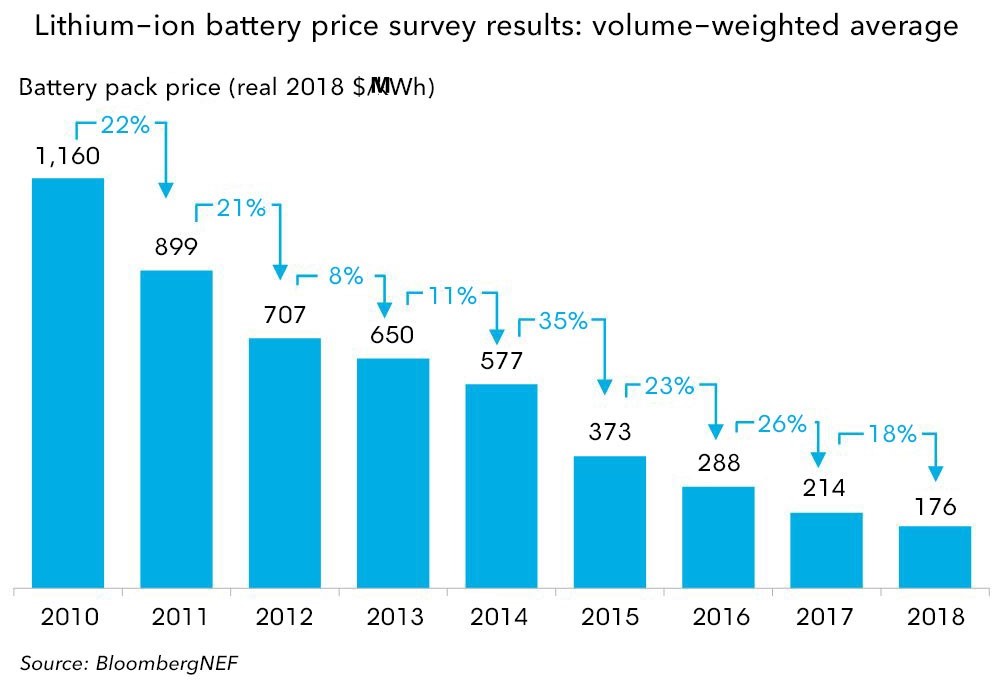
Let’s look at the numbers. Based on the data collected by Bloomberg New Energy Finance in their annual battery price survey, the best available industry pricing benchmark, the average battery pack price fell 85% in the eight years from 2010, reaching an average of $176 per megawatt-hour in 2018 (see graphic).

Battery Prices 2010-2018

Battery technology has driven a price decline of the same magnitude as that which we’ve observed for solar energy. And as we’ve observed with solar, understanding the competitive position of an energy source using prices of the past, or even the present, leaves planners well out of date. Price being quoted for renewables-plus-storage of only five years ago, in the 20 cents per kilowatt-hour range – making them far more expensive than thermal electricity alternatives – have given way to prices 50-75% below this level, as we’ll see below. In only a few years, storage has gone from a niche concept to the new game in town. And much in the same way that solar energy price “records” have been being set continuously, each being greeted by disbelief that prices can reach this low, solar-plus-storage price records are now the stuff of headlines.

Four 2019 examples from different US states illustrate the bigger and cheaper trend.

  • Hawaii. In January 2019 the Hawaiian Public Utilities Commission approved contracts for six projects, with a capacity of 247 MW of power and 998 megawatt-hours of storage. This was the second largest “solar-plus-storage” project globally, behind only Moss Landing in California. The price range for the six projects came to between $0.08-$0.10/ KwH, prices cheaper than both Hawaii’s gas peaker plants and current cost of baseload fossil fuel plants (around 15 cents, given the high cost of transporting fuel to the islands). Developers include AES, Innergex, Clearway and 174 Power Global.
  • Florida. In late March 2019, Florida Power & Light Company announced it was building the world’s largest battery energy storage system, The FPL Manatee Energy Storage Center. At 409MW capacity, the project is claimed to be four times larger than the largest battery currently operating worldwide. FPLC also announced that the plant would help accelerate the decommissioning of two 1970s-era natural gas power units. Manatee Energy Storage Center would be linked to an existing PV plant, and start operating in 2021. FPL expects customers will save more than US$100 million through the change. This was a twist for FPLC’s existing modernization program which had focused on replacing oil-based power plants with U.S.-produced natural gas units. The natural-gas units were no longer the cheapest alternative for FPLC.
  • Nevada. Nevada in 2018 announced a huge solar-plus-storage procurement at then world-record prices, just below four cents a Kilowatt-hour. In June 2019, the Berkshire Hathaway-owned utility beat the one-year old record, announcing three new solar projects totaling 1,200 MWs paired with 590 MWs of storage. One of the projects, at 690 MWs, would blow past FPLC’s Manatee project to become the largest solar plant in the US. The winning bidders were developers 8minute Solar Energy, EDF Renewables and Quinbrook Infrastructure Partners with Arevia Power. 8minute said its project could run 65% of the time during peak summer hours, more than double the 30% average for solar in Nevada. 8minute said its project, at 300 megawatts of solar and 135-megawatts of 4-hour storage, will sell electricity at $0.035/KwH, a new world record low.
  • California. In early September, 2019, Los Angeles’ municipal utility approved the contract for Eland, a project for 400 MWs of solar power with up to 300 MWs and 1,200 MWHs of energy storage. Winning bidder 8minute offered a power-plus-storage rate of less $0.04/KwH for 25-years. The effective capacity of the project is expected to be 60%. Buyer LADWP is the largest municipal utility in the U.S., serving more than 4 million people.

With these there are now 9 energy-plus-storage projects underway with a capacity of over 100 MW (The Biggest Batteries Coming to a Grid Near You: the 100 MW Club is about to get a lot busier). With these new utility procurements dominating the news, the US is expected to regain the position of the world’s largest market for energy storage. 2019 is also widely expected to be the first year in which energy storage investments top $1 billion, from $500 million in 2018. Interestingly, the world’s largest market for storage in 2018 was South Korea, helped by a combination of strong incentives to reduce reliance on imported oil and coal and its well-developed domestic technology sector. South Korea procured over 1 GW of energy storage in 2018. However, fires related to Lithium-ion batteries have occurred at some 35 locations in the country, leading regulators to significantly slow down procurement. Problems appear to have been related to battery management systems rather than the batteries themselves, and similar issues have not been reported from other markets.

Interestingly as well, one can note that the world’s largest market for energy storage these last two years was not the one which might have been expected: China. In related technologies China has become by far and away the world’s biggest market for solar energy, and has an even larger lead in electric vehicles and vehicle batteries (almost 99% of the electric buses on the road today are in China). Yet China does not have a similar leadership position in solar-plus-storage – yet. China brought on-line a reported half-gigawatt of energy storage in 2018, equal to previous installed capacity, but well behind the US and South Korea. This surprising slow market development seems to stem from administrative regulations, which have compensated storage on an essentially cost-plus standalone basis, and the relative novelty of solar auctions to date in the country. With the announced administrative changes from China’s National Energy Administration, integrating storage into spot market pricing, demand is expected to jump substantially. Wood Mackenzie projects China’s cumulative energy storage capacity to grow to 12.5 gigawatts in 2024, a 25-fold increase in the current installed base, and about 14% of the projected global market in 2024. Looking at China’s track record in solar and in batteries, this may well be under-estimated. India also began to procure energy storage in 2017, and tendered for just under 100 MWs in March of this year. To date, India, though the second largest global market for solar power now, is a tiny player in storage. Lack of policy clarity has been a major issue, with a set of 2017 tenders having been cancelled without explanation early in 2019. Prime Minister Modi has launched a National Mission on Transformative Mobility and Battery Storage, under which a program will support the setting up of battery gigafactories across India. One can also expect the energy-plus-storage market in India to grow substantially.

Where to from here?
Looking forward, four key items stand out in attempting to foresee the renewables-plus-storage market of the future.
1) Still-lower prices and continued fast demand growth. Bloomberg NEF projects, based on a historically observed experience curve showing prices dropping 18% for every doubling of volume, that average prices of battery packs will fall from the current $176/KwH to around $94/Kwh by 2024 and $62/Kwh by 2030. Based on BNEF’s calculated present $0.06-0.07 premium to add four-hour storage to renewables, this would imply prices of energy-plus-storage falling below $0.06 per kilowatt-hour fairly widely – well below the cost of producing energy from greenfield coal plants. BNEF’s latest report on the battery market states “batteries co-located with solar or wind projects are starting to compete, in many markets and without subsidy, with coal- and gas-fired generation for the provision of ‘dispatchable power’ that can be delivered whenever the grid needs it (as opposed to only when the wind is blowing, or the sun is shining).” As we have been seeing already in several states, these declining prices will lead to rapid substitution – for investments in new electricity capacity — of renewables-plus-storage for fossil-fuels. Wood Mackenzie estimates that by 2024 global cumulative capex investment in energy storage will top $70 billion. This is a big deal, and a big disruption – or better put, yet another big disruption – for “traditional” energy markets. We can, in tandem with this growth, expect sharply declining demand for gas-plants (and so continued historically low natural gas prices). Wood Mackenzie projects that over 6 GW of planned gas-peaker capacity is at risk of cancellation in the US in the next few years; if storage costs continue to decline at double-digit levels annually, as they have done, then gas cancellations just in the US could run to 15 GW, or 80% of planned additions through 2026. In markets where natural gas is more expensive than it is in the US, substitution may occur even faster.
2) The hunt for the Next Big Thing continues. There is, of course, a catch to the rosy picture of renewables-plus-storage. It’s not in the well-publicized issue of the cost of cobalt, a key raw material for lithium-ion batteries of which more than half comes from war-torn Democratic Republic of Congo: costs of cobalt had spiked in 2016-7, but have fallen since as more efficient battery processes reduce demand. The catch is that lithium-ion batteries work well for providing critical four-hour storage, but not more. So while they are rapidly are becoming the best bet for dispatchable peak power, they don’t yet provide the equivalent of baseload, available 24-hour a day power. The search for the best longer-duration options continues. Pumped-hydro, which uses extra power to pump water uphill which can be used to turn a turbine and generate electricity when needed, is cost-effective but capital and space-intensive, so cannot be used in that many places. Flow battery technology gathers a lot of interest, but prices are prohibitive today for deployment, so much depends on whether the technology will gather the kind of cost-reduction which lithium-ion has.
3) Emerging Markets lag far behind. If we look at trends in relative economic growth, electricity consumption, and solar energy investments, we would expect that in the near future Emerging Markets would account for a large share, and certainly more than half, of demand for a centrally important energy technology such as storage. Yet unless we consider OECD-member South Korea to still be an Emerging Market, these countries account for less than 5% of today’s renewables-plus-storage market. By contrast, Emerging Markets account for roughly 2/3 of all solar and wind investment globally. The big bottleneck in emerging economies’ adoption of energy storage at scale is – and will continue to be — administrative capacity. We can see in the booming US market the amount of work which went into setting standards, regulations, and procurement programs. And we can see that in the two biggest emerging economies, China and India, policy choices have contributed to a slow rate of adoption to date. It seems that now China may have found a better procurement approach, but time will tell. We can also expect, as a corollary to this issue, that there will be a very large need for capacity-building, policy and technical support across emerging economies, to help them on the next stage of power availability and cost reductions. We can also expect that their success in doing so will have a very large impact on how big the storage market becomes, and how fast. Failure to get the procurement and regulatory environment right will likely mean a smaller global market than now estimated. Success, especially in China and India, may imply a significantly larger global market for battery storage than analysts are now projecting.
4) A push from policies? Wind and solar generation, in their early growth years, benefitted from significant policy support and subsidies. Now both technologies have reached the point that they are outcompeting alternatives on an economic basis without subsidies. In contrast, energy storage has benefitted significantly less from subsidies, as has renewables-plus-storage. For wind and solar in their early years, the medium-term question in forecasting market size was whether they would lose subsidies. For energy storage, a key medium-term question may be the exact opposite: will storage see new subsidies and policy support that it has not previously? If so, then the market may become much larger much faster than analysts presently predict. In an age of fiscal constraints and anti-renewables stances like that of the current US President and the oil and coal industries, this may seem far-fetched. But as Infrastructure Ideas has noted previously, energy policies may become substantially different in the future. Such a change depends largely on one’s views on the unfolding of climate change. If extreme weather events – floods, storms, wildfires and drought – continue to rapidly become more frequent and severe, as seems to be the case, and if data shows that keeping emissions even close to, let alone below, 2 degree warming scenarios has become essentially impossible, then the likelihood of more drastic climate-related policy actions increases substantially. Infrastructure Ideas sees this as the likeliest scenario, and probably within a five-year horizon from now. In such a scenario, “organic” growth of renewables and storage in electricity generation – as impressive as that growth now looks – may come to be seen as far short of what is wanted by voters and policy-makers. And in such a scenario, subsidies and other preferential polices favoring renewables-plus-storage combinations become one of the likeliest policy tools – further accelerating the current “organic” growth of storage. Stay tuned to the Weather Channel…

Asia’s Energy Transformation: India

Asia’s Energy Transformation: India
August 2019

This is the fourth in a series on the ongoing, large-scale transformation of energy use in Asia. Previous columns have focused on Pakistan, Bangladesh and Indonesia. As we noted in earlier installments of the series, Asia is the most important global market for energy consumption, investment, and greenhouse-gas emissions. And it is a region undergoing a large-scale energy transition, whose unclear evolution has more importance to the future of both climate change and energy investments than that of any other region.

With over 1.3 billion people, India is the world’s second most populated country, and accounts for about 18% of all the people who live on earth. Somewhere around 2024 India will become the most populated of all. Yet it consumes only about 5% of the electricity produced globally. About 200 million people in India live without electricity, and about twice as many have access for less than six hours a day. Prime Minister Narendra Modi, elected in 2014, has made it a priority to change this, and provide universal electrification in India. Plans provide for roughly a tripling of the country’s electricity generation over the next two decades, a central plank to India’s development and poverty-reduction efforts. Good.

When Prime Minister Modi took office, 2/3 of all power produced in India was generated from coal. Were the plan to triple power generation to succeed the same profile of where power comes from, it would imply adding more greenhouse gas emissions annually than the amount produced annually by the United States. Bad. So Modi has also proposed an unprecedented ramp-up in renewable energy generation. India’s ability to raise electricity availability is critical to development and poverty reduction, yet how it does so will also have a crucial impact on the global environment. So India’s energy challenge is one in which both India and the rest of the world have a huge stake.

The good news is that so far, India’s bet on renewable energy has succeeded far better than most observers expected. Five years ago, when Modi was elected, India’s total renewable energy production capacity was 34 GW, about 10% of its power capacity, mostly consisting of hydropower, with solar capacity at a tiny 1.5 GW. Today renewable energy capacity stands at 80 GW, with essentially all the growth having come from solar and wind farms. This has vaulted India up to 5th globally in renewable energy production, behind China, the USA, Brazil, and Germany, and 4th (ahead of Brazil) if hydropower is excluded. The country’s well-publicized 2022 renewable energy target (just three years from now) is 175 GW, more than double current capacity – and about equal to current combined wind and solar capacity of the USA, or to the world’s total generation capacity from wind and solar power a short decade ago. Doubling wind and solar capacity in three years would seem nearly impossible – except for the fact that this is exactly what India has done over the previous three years.

A big part of this success story, as has been the case in other countries bringing on stream large amount of solar and wind power, has been rapid price decreases. As renewable auctions got underway in Brazil, South Africa, and other places, driving costs down by 75% in 3-4 years in several countries, India seemed like it would be on the outside looking in at the renewables boom. With high foreign exchange risks, government bureaucracy, and loss-making state-owned electricity distribution companies, analysts initially thought India would find it hard to bring solar costs down below $0.10/KwH – double what some countries were seeing, and well above the cost of alternative ways to raise electricity production, mainly through coal. Yet India managed to become a part of the global solar boom, with prices dropping almost monthly for three years. The cheapest prices offered for generating solar have come down to $0.036/KwH (still double world lows – see And Prices Keep Falling), or about half of what power from a greenfield coal-fired plant could be expected to cost.

In a country as large as India, with states as politically diverse as it has, it is unsurprising that adoption of renewables has varied widely across the country. Rajasthan and Gujarat have two of the largest solar programs and the lowest prices. Tamil Nadu’s late 2017 solar auctions brought signed offtake agreements at $0.054/KwH, compared to previous capacity additions there at $0.12. Renewables there are set to account for 35% of total generation capacity in the state. Karnataka and Telangana each added 2 GW in 2018. Several states, however, have no solar generation at all. The government of one state, Andhra Pradesh (AP), has managed to be good news and bad news all in one. On the one hand AP announced a very large short-term target of installing 18 Gigawatts of renewable energy by 2022, almost 20% of the total national target for the period, and tripling AP renewable capacity. Good news. On the other hand, in May newly elected AP Chief Minister Jaganmohan Reddy called for retrospective renegotiations and cancellation of existing contracts for wind, solar and storage contracts in the state. Bad news. At issue is that prices for renewable capacity contracted in the previous 5-6 years are now much higher than prices based on rapidly advancing technology. Not that previously contracted prices are particularly high in AP – tariffs being contested are in the range of 5-8 cents/KwH. These are still attractive prices relative to power generation costs in many countries. The AP problem, however, which is not unique to AP, is that a combination of gross inefficiencies in the state-owned power distribution companies (India has the highest grid losses of any country in Asia, at an average of 25%) and subsidized prices for some consumers means that state-owned distribution companies are virtually bankrupt, and the new Chief Minister seeks to squeeze improvements any way he can. Andhra Pradesh Southern Power Distribution Company (APSPDL) and Andhra Pradesh Eastern Power Distribution Company (APEPDCL), have lost $220m together in the last year. You can see the political logic driving him, but the cost in lawsuits, and the driving away of operators from AP – reducing competition for future capacity bids – is likely to be a very steep price for breaking contracts. As India looks to achieve its 175 GW target for renewable capacity by 2022, and equally ambitious capacity growth targets beyond this, the roadblocks that have stymied even faster growth will have to be overcome.

Roadblock #1 to faster renewable growth in India is the coal lobby. This consists of many actors, the most powerful of which is Coal India Limited, who among other things provides significant tax revenue and employment in India’s poorest states. Indian Railways transports most coal and over-charge for coal transport to subsidize passenger prices. And even as Modi’s government sets highly aggressive targets for the growth of renewable energy, it has continued to declare in parallel that it will build more coal plants on a large scale. Roadblock #2 remains the credit risk of state-run off-takers. India’s distribution companies collectively lose hundreds of billions of dollars a year – despite the fact that new power sources are getting rapidly cheaper. Most would be bankrupt if not haphazardly propped up by governments. It’s a very large-scale problem: A new World Bank report titled, “In the Dark: How Much Do Power Sector Distortions Cost South Asia,” says India’s power sector inefficiencies cost the economy about 4% of GDP a year. And it’s a big problem for new renewables producers whose financial future depends on their off-takers being able to pay their bills. Roadblock #3 is predictability, along with India’s tradition of economic statism. One example is attempts to renegotiate contracts for political purposes, as seen above in the case of Andhra Pradesh. Another is the attempt to force government-owned firms into the picture. That until recently solar and wind auctions in India had functioned as they have everywhere else, with private sector firms being the bidders to provide new capacity, has run against some of India’s economic traditions. Especially in infrastructure, India’s history is one of state control. This June, India tried to turn the clock back in this direction with an auction for 1.8 GW of new solar capacity… which was only open to state-run firms. Though it seemed a shock to the organizers, it was not a shock to anyone else when the auction was undersubscribed by 2/3, drawing bids for just over half a Gigawatt. Very few state-owned companies (leaving aside partially state-owned exceptions such as Italy’s ENEL or France’s EDF) are nimble enough to keep moving down the production cost curve as aggressively as private producers have done this last decade.

These are pretty big roadblocks. In spite of the historic growth of solar capacity, many observers still believe coal will continue to dominate power in India (see Coal is King in India – and Will Remain So, from Brookings). India is the third-largest coal-fired generation producer globally, behind only China and the USA. Even at the impressive level of 80GW, renewables account for only 40% of the electricity generating capacity that coal-fired power does. And when generation factors are accounted for (meaning how often wind and solar plants are producing actual electricity), coal produces still 7 times the power that renewables do in the county. In 2015, India had plans for adding another 100 GW of coal-fired power generation over 5 years, which briefly became (as China’s announced programs shifted) the largest single-country pipeline in the world for new-build coal capacity. Nonetheless, the coal lobby has a big problem of its own. While formerly expensive solar is getting cheap, formerly cheap coal is getting expensive. Since 2007, bid prices to provide new coal-fired have essentially doubled, from as low as $0.036/KwH to $0.07 by 2013. The average price for coal-fired power on Indian exchanges in 2018 hovered around 7 cents/KwH. And while new renewable PPAs are price-fixed without inflation (meaning real prices on the contracts will actually decline over time), coal power is subject to inflation in the price of coal and other operating costs. Transport inefficiencies, disruptions in imported coal supply (as many coal mines cease to operate due to declining or unpredictable demand), and problems in the domestic mining sector have contributed to the rise, and decline in prices is unlikely. Some new coal plants are being commissioned (about 3 GW in 2018), though decommissioned older capacity means net coal generation is no longer growing. At least for now. This compares with net additions of thermal generation capacity of 20 GW annually from 2012-2016. And four years into the announced plan to add 100 GW of new coal-fired power from 2015 to 2020, only about 10% of this has been built. Plans still call for another 90 GW of new plants by 2026. Let’s see. Either way, the consequences of the next set of procurement decisions will be very large.

As the political power of coal and the economic gains of renewables square off, the future direction of energy in India may depend in large part on developments in energy storage (see Fortune India — Why Storage is the Next Big Thing). The issue with solar and wind is of course their intermittent nature. This is a manageable issue when intermittent power accounts for a small share of total electricity on a grid. Though that share is growing in India, the technical weaknesses of India’s transmission grids means problems occur at lower penetration levels of intermittent power, and Indians are naturally loath to see more country-wide blackouts as the monster experienced in 2012. Therefore the potential value of energy storage, enabling renewable energy to be released to the grid at times when wind is not blowing or sun is not shining, is even higher in India than in other places. As a forthcoming Infrastructure Ideas column will review, battery storage costs continue to plunge worldwide, and storage + renewables projects are beginning to replace even relatively cheap gas-fired capacity in the US and elsewhere. The Government issued its first large-scale tenders for storage in March 2019, and states are beginning to follow suit. The cabinet has approved a National Mission on Transformative Mobility and Battery Storage, which aims also to manufacture batteries on a large scale domestically. With India’s world-class engineering skills, one should expect energy storage built in India to be cost-competitive with storage projects in the US and Europe.

Compared to the ongoing energy transition in other countries, the above snapshot may seem to be missing a third player: natural gas-fired electricity generation. In the US, gas has played the largest role in recent energy shifts, and it is playing a big role in new capacity plans in China, the Middle East, and Latin America. It is also a key question mark for Bangladesh, Pakistan, and Indonesia. For India, there is less to talk about. Sure, India is building both gas import terminals and new gas-fired plans. There are offshore gas reserves, as there are for Bangladesh. But the scale, relative to the massive existing coal fleet and the massive renewable plans, is hardly worth talking about. It could become a bigger factor in the equation for India, but only if (a) the government allows prices for domestically produced gas to come closer to international prices, and (b) it also supports investment in transporting gas throughout the country.

Hydropower will also play some role, though the better hydro sites in India have already been developed, and recent dam-building history is filled with cost overruns, social displacement and construction problems, so it’s hard to see this as more than a minor actor. In Eastern India, imports of hydro-produced power from Bhutan, and maybe gas-fired power from Bangladesh, may play a regionally more important role. But on the large scale of large India, this is not where the main battle will play out.

Keep an eye on India. The development and living standards of hundreds of millions depend on continued economic progress there. As does the extent to which the planet will get hotter. High stakes. And a Top 3 coal power going against a Top 3 renewables plan – the stuff of Bollywood epics for years to come…


And the Prices Keep Falling (II)

And the Prices Keep Falling (part II)

In the first of this two-part post, And the Prices Keep Falling, Infrastructure Ideas highlighted the hugely positive side of this Summer’s remarkable solar auctions in Brazil and Portugal. With the price of new solar – and wind – generating capacity continuing to fall to record low levels, energy is getting cheaper for nearly all. And cleaner.

Yet there is a dark side.

Today’s post outlines some less positive consequences of these falling prices for two important sets of players. And we don’t mean the fossil fuel industry. Falling prices have downside for solar investors and lenders, and – surprisingly – for some of the countries who most need solar and wind power.

Falling costs (as distinct from prices) can affect industries in different ways. In some industries, producers are able to maintain previous price levels, or at least ensure that prices fall more slowly than costs. This drives higher profits, and is naturally the outcome to which most firms aspire. In other industries, prices fall as fast, or even faster than costs. This is the kind of outcome which disproportionately benefits consumers. As economists would frame it, consumers are capturing most – if not all – the benefits of falling costs. The solar and wind generation sectors are an example of the latter.

Why this should be the case is a good question, but one with a simple answer. Consumers, and consuming countries, have captured most or all of the benefits of falling solar and wind costs for one reason: competitive auctions. The across-the-board switch from older power procurement methods — negotiated contracts, and feed-in-tariffs – to competitive price-based auctions was pioneered in large Emerging Markets, notably Brazil and South Africa, in the early 2010s. now it is highly unusual to see utility-scale procurement on any different basis. A Bloomberg New Energy Finance analysis in 2016 found that the switch to auctions was responsible for as much of the price decline in countries which adopted them as were technology cost declines.

But what is great for buyers is becoming increasingly problematic for investors and lenders. Prices in recent PPA auctions are falling to such levels that little room is left for either unforeseen operational risks, or for the cost of capital. Already in mid-2018, UK consulting firm Cornwall Insight projected that unsubsidized solar projects would be unviable by 2030 (what happens when renewables eat their own profits?), in this case because of pushing wholesale prices in the UK down so far. Wood Mackenzie’s Emma Foehringer Merchant wrote back in January 2019 of a “finance bubble” in the solar industry. Looking at results of recent solar auctions, Merchant noted “A flood of new investors, like pension funds and insurance companies, now view solar as a stable asset. That “wall of money” going after a smaller pool of projects has created a market so competitive that many sponsors are willing to accept lower-than-average returns. Power-purchase agreement prices have also fallen to new lows, and contract terms have gotten shorter. Industry financial experts say, taken together, those trends have led to a mispricing of risk.” The chorus has become louder after this Summer’s below 2 cents/KwH auctions. A piece by Wood Mackenzie’s Jason Deign (Key to those record-low solar bids?) looked at the mechanics of bidders’ approaches to preparing these super-low priced bids, and concluded that bidders were offering very low prices for Power Purchase Agreements with the idea that they could sell power for higher prices in later years in merchant markets. An assumption which, given the recent history of how fast prices are falling, would seem highly unrealistic.

These emerging risk profiles for new solar and wind generation investments are getting further and further away from “traditional” electricity industry risk profiles, which assumed steady long-term revenues and predictably stable conditions for the life of 15 to 20-year loans. Normally lenders to such projects would adjust to higher risk and lower predictability by charging higher interest rates, but with prices falling so far and margins getting squeezed, new projects and owners have no room to accommodate higher rates – and indeed are strongly pressuring lenders to squeeze margins further down. A likely outcome? Lower profits and higher risks for renewable energy lending portfolios.

As solar becomes a larger and larger – and lower cost — market, one would think this is all good news for industry players, though we see it is not. And there’s another group for who one would think it’s all good news – but it’s not – or at least not for some of the group. This group? Low-income countries.

In principle low-income countries are the potentially biggest beneficiaries of low-cost wind and solar. Often the countries with the biggest electricity deficits, the highest costs of power, and the least money with which to add generation capacity, low-income countries stand to benefit disproportionately from plunging solar costs. And those that move to join those countries establishing competitive procurement auctions will do just that – benefit disproportionately. Their development and economic gains will be huge. The catch? Not all will manage to do so.

The difficulty for many low-income countries lies in organizing access to this new bounty of cheap solar (and wind). It will not happen by itself. Implementing competitive auctions is not an impossible task, but it does require organization, administrative competency, and ability to deliver on a process once it is announced. Many low-income countries face two important hurdles to achieve this. The first hurdle is weak administrative capacity to organize auctions. Auctions, after all, often differ radically from existing procurement mechanisms in many low-income countries, and a poorly handled process can significantly limit interest from solar companies – leading to less competition and unnecessarily high bid prices. This is a hurdle which can be surmounted, but often requires assistance from advisers who have done it before. The second hurdle is probably the higher. The second hurdle is the power of vested interests who benefit from existing arrangements – often high cost, inefficient arrangements. Foremost among these may be the national monopoly utility, and those in charge of supplying raw material – oil or coal – to the existing generation fleet. These vested interests may have significant political power and influence, enough to derail the implementation of administratively complex and novel competitive auctions for solar.

For countries which fail to overcome these two hurdles, the future is bleak. In a world where more and more countries are able to achieve lower energy costs through procurement of low-priced wind and solar generation, those countries whose energy costs are dominated by high-priced, “traditional” thermal electricity resources will become less and less competitive, and fall further behind their neighbors. Failure to join the low-cost renewable energy club will carry very high opportunity costs, both in terms of development, and of foregone economic competitiveness.

So cheer low cost solar. And encourage all not to be left behind.

Asia’s Energy Transformation: Indonesia

On April 17, voters in Indonesia went to the polls and apparently re-elected President Joko Widodo (“Jokowi”) to a second term. Final results are due May 22. This election, and President Jokowi’s second term, if early results are confirmed, will have momentous consequences for infrastructure, energy and global climate.

This is the third in an Infrastructure Ideas series on the state of Asia’s Energy Transformation, following earlier reviews of the energy situation in Pakistan and in Bangladesh. Indonesia shares many commonalities with the other two countries: one of the ten most populated countries in the world (with over a quarter of a million people, Indonesia has the 4th largest population), facing energy high demand growth while running out of domestic fuel sources on which it has relied, and strongly considering a large-scale expansion in its coal-burning capacity to meet its energy needs. The energy choices Indonesia makes in the next few years will have major effects on the availability and cost of energy for Indonesians, and on global climate.

President Jokowi’s initial election, in 2014, was widely greeted as great news for infrastructure in Indonesia. His electoral platform stressed implementing reform programs needed to address Indonesia’s widespread and longstanding infrastructure problems, including beginning to bring in private capital and reduce reliance on Indonesia’s state-owned monopolies. His first term did not live up to expectations on this score: government bureaucracies and vested interests have been largely successful in limiting change. Yet needs continue to grow, and the same problems and choices will now face a second Jokowi administration.

Energy is the most critical battleground between the Indonesian old guard, clearly proponents of both maintaining state control and relying on Indonesia’s coal resources to meet energy needs, and reformers. Indonesia’s current electricity consumption and production are very low for a country of its size, with production capacity of about 60 Gigawatts (GW), slightly over half of which is coal based. The country’s “Electricity Supply Business Plan” (Known as RUPTL) calls for a near-doubling of capacity, to 115 GW by 2025, including from 25 to 35 GW of new coal-fired capacity. This places Indonesia among the five countries with the largest plans for new coal-fired power.

Indonesia’s coal resources are large, and unlike Pakistan and Bangladesh, the country has been developing and exploiting these at a large scale for decades. Indonesia ranks as the fifth largest coal producer globally (After China, the US, Australia and India), and is the world’s second biggest exporter of coal, after Australia. Those resources, however, are not unlimited: Price Waterhouse Coopers forecast that at planned utilization levels, the country’s coal resources would be exhausted by 2033.

Indonesia’s domestic energy resources are not at all limited to coal. The country was an oil exporter, until falling oil production turned into an importer. It has widespread hydropower potential, albeit complicated by land ownership and biodiversity considerations, and among the best geothermal energy potential of any country. About 9 GW of total electricity capacity today is renewable energy, mostly hydropower. The latest RUPTL projected a 300% increase in renewable energy capacity by 2025, to about 35 GW: 6 new GW of geothermal, 12 GW of large-scale Hydropower, and 8 GW of wind and solar (mostly wind). However, development of renewable energy has been largely stalled, due to a combination of land/biodiversity issues affecting hydro and geothermal projects, and of inability to get wind and solar-based power production off the ground. As a result, unlike many countries which are rapidly ramping up the share of energy use based on renewables – largely because these have become the cheapest alternatives, Indonesia has been stuck: not moving forward, and trying to do so mostly with coal-fired megaprojects. President Jokowi’s legacy in Indonesia will be largely determined whether in his second term he succeeds in getting the power sector unstuck, and in moving the country into exploiting low-cost wind and solar electricity, or whether he remains mired in Indonesia’s bureaucracy and vested interests.

Part of the roadblocks to Indonesia’s development of renewable resources is complicated: the land and biodiversity issues which are involved in many potential large-scale hydropower or geothermal projects will not easily be solved. But another part is simpler: country after country is taking advantage of the combination of free-falling technology costs in wind and solar and of auction mechanisms which force competition among the world’s still-growing number of producing companies. IRENA has stated that Indonesia has 47 GW of solar power potential. At least, better said, technically simple. And economically simple. The officially estimated cost of greenfield coal-fired generation may be lower in Indonesia than anywhere else ($0.05/ kilowatt hour), but those estimates like in many other places underestimate both coal transport costs and the impact of current disruptions in the coal market, without pricing in likely medium-term scarcity costs. Wind and solar prices are already on a par with the low-end of coal-based generation prices, and continue to fall.

Where large-scale development of wind and solar electricity in Indonesia is not simple is in the politics. The state-run power utility, PLN, combines a monopoly of transmission and distribution with being the by far largest producer of power. It is an artefact in a world where most countries have separated power generation from T&D responsibilities, and where most have increasingly turned to private capital for financing new generation capacity. And as both a competitor and the eventual buyer of wind and solar power from potential new producers, its enthusiasm for the wind and solar auctions which have triggered rapid growth in renewable capacity in many countries has been superficial. PLN would far rather build power plants itself – which means thermal or possibly hydropower power – than have others build them. Its reasons are a mix of classic bureaucratic inertia and self-interest, and of links to political interests and corruption. The reasons are not economic: the government has pumped between $3 and $4 billion annually into PLN in recent years to cover losses, and letting others finance power which will come at a lower cost to PLN would reduce those losses. A recent documentary released in Indonesia, which the government has tried hard to suppress, is named “Sexy Killers,” and highlights the links between the country’s coal industry, PLN and politicians. And as noted in a recent column by Bill McKibben, the potential for bribes in small-scale, decentralized wind and solar development is far smaller than it is where single mega-projects such as coal plants involved.

The past few months have seen somewhat of a stalemate. A few renewable projects have inched forward, as have a handful of natural gas-fired projects. But large-scale auctions for wind and solar have made no progress. The 2019 RUPTL, released in March, gave more verbal support to wind and hydropower, though without indicating it would take practical steps to bringing this closer to reality. A number of coal-fired plants planned in Java were reportedly suspended or cancelled, yet have re-appeared in the new policy document, and plans for solar are minimal. As noted in its review of the RUPTL, IEEFA called the statements about incorporating more renewables “a cut-and-paste planning exercise that does little to address fundamental problems with Indonesia’s over-reliance on coal-fired generation,” and stated that “Indonesia appears to have embraced what can best be described as a contrarian understanding of power trends with the decision to add less than 1 GW of solar over the next decade.”

On April 23, the arrest was announced of PLN’s CEO, Sofyan Basir, on charges of corruption related to a $900m coal-fired power plant. Unlike in the case of competitive public auctions in wind and solar, this coal project – Riau I – was awarded directly by a PLN subsidiary to a Singaporean company (arrests include one of the Singaporean company’s Board members). A sign of the tide turning? Indonesia’s energy and economic future hangs on the decisions that will be made by President Jokowi in his second term. As does a lot of carbon.

$3 billion for Mobility in the Middle East

In June 2018, Infrastructure Ideas surveyed the mobility revolution in transport. It was clear that capital was soon going to be flowing here in amounts rivaling traditional transport sectors such as ports, airports and railways. And while 95% of the capital to date in these sectors was being deployed in OECD countries, we predicted that soon, as in most areas of infrastructure, the majority of new capital would be seeking out higher growth opportunities in Emerging Markets. It didn’t take long to check that prediction.

Last week, Uber announced that it would acquire the Middle East’s largest ride-sharing service, Careem, for over $3 billion.

This will be one of the largest private infrastructure transactions to date in the Middle East. And for a company that is barely six years old. Careem, based in Dubai and operating across fifteen countries in the Middle East and surrounding areas, was founded in 2012. Ride-sharing was not even its initial business, as it was founded as a corporate car service, before following consumer demand into ride-sharing and delivery services similar to Uber Eats. Large markets served by Careem include Pakistan and Turkey.

For Uber, this is not only big money, but a departure from how it has addressed its Emerging Market competition to date. In China, in Indonesia, and in Russia, Uber has previously chosen to sell its in-country operations to local rivals, preferring to raise cash to cover losses, rather than maintaining loss-making operations in more countries. The Careem acquisition signals that as it edges closer to breaking even and to profitability, Uber may now be more willing to pay for control of Emerging Market rivals. Uber is initially signaling that Uber and Careem services will run in parallel in the dozen or so countries where the two both operate. CEO Mudassir Sheikha will continue to run Careem, according to Uber’s announcement. China’s Didi Chuxing, the biggest ride-sharing company in China, has been one of Careem’s largest investors. Careem’s previous fund-raisings had generated some $800 million, and analysts place Uber’s acquisition price at about a 50% premium to previous valuations.

The announcement follows by days the IPO by Lyft, which valued Lyft at $22 billion. Uber’s preparations for an IPO have been widely covered, with an expected valuation of around $120 billion.

This is another sign of how technology, after revolutionizing the energy business, is having a larger and larger effect on other parts of the infrastructure world. As we’ve previously written, for investors, staying locked into traditional segments and failing to understanding the impacts of technology will carry a high cost in missed opportunities.

Asia’s Energy Transformation: Bangladesh

Asia’s Energy Transformation: Bangladesh

This is the second in an Infrastructure Ideas series looking at the way energy use is changing in Asia’s major economies, and the momentous choices facing policy-makers there today. Following the previous post covering Pakistan, this post features the world’s 8th most-populous nation – and the country with one of the five biggest project pipelines for new coal-fired generation: Bangladesh.

Bangladesh, known as East Pakistan from 1949 to 1972, is the most densely populated country in the world. Its energy profile has many similarities with that of Pakistan: both countries have enjoyed significant domestic natural gas resources, which played a major role in the development of the countries’ power grids – Bangladesh’s even more than Pakistan’s. Both Pakistan and Bangladesh are relatively low-income, and have among the lowest per capita levels of energy consumption in the world, and among the highest aspirational rates of growth for future energy consumption (Bangladesh’s growth rate has been in the 6-7% per annum range). Both countries subsidized consumption of domestic natural gas resources by keeping prices well below those prevailing internationally, and in part as a result reserves have been in decline and the ability to keep supplying gas-fired power plants is now in question. Both countries have largely untapped domestic coal reserves, generally of low quality, and coal enjoys a major role in future energy planning in both. Bangladesh and Pakistan are also late-comers to renewable energy (leaving aside Pakistan’s large hydropower capacity), with Pakistan having turned somewhat earlier to initial wind and solar power auctions.

Critically, both countries face a similar fork in their energy roads: build substantial new coal-fired electricity generation capacity – potentially making them among the 3 or 4 largest builders of new coal plants in the world – or encourage large-scale development of wind and solar power. The policy choices these two countries make will have major implications for their economies and people, as well as for global climate.

Thinking about growth is essential for understanding Bangladesh’s energy choices. The country’s total power generation capacity in 2015 was only 10 Gigawatts: more than 40 countries produce more electricity than this, while only 7 have more people than Bangladesh. And this is after roughly doubling Bangladesh’s capacity in the last decade. Bangladesh’s energy policy calls for raising power capacity by 2030 to 30 Gigawatts – triple the amount of electricity produced today. That’s growth! Bangladesh needs this much power, both to make up for its very low current consumption, and to support the high growth rate of its economy.

The issue for the country is that its current sources of energy cannot keep up with existing capacity, let alone this projected tripling. Today three-quarters of electricity in Bangladesh is supplied by natural gas, and Bangladesh is running out of it. Reserves are projected to be exhausted somewhere around 2029. Taking advantage of the changes in the natural gas industry – which in the last decade have made it an internationally traded commodity – Bangladesh has begun to invest in import terminals to bring external natural gas into the country. This makes plenty of sense as policy. However, the new imported gas is likely to be needed entirely to substitute for declining domestic gas sources, and is unlikely to be a major source of new capacity. Concerned as well as it is by today’s over-reliance on gas, Bangladesh’s government has focused on diversifying energy sources, which again makes sense. The question is how best to do this.

The Government of Bangladesh’s stated energy plans have for years focused on one principal answer: develop coal. While coal produces less than 500 MW of electricity in Bangladesh today, government projections have shown 2030 capacity as high as 20 Gigawatts – essentially all the planned increase in electricity production for the country. A 20 Gigawatt coal-fired pipeline would place Bangladesh – which is not in the 40 largest power producers today – 5th in the world in new coal-fired capacity: after only China, India, Vietnam and Indonesia. Bangladesh also has an important friend ready to support this policy choice: China. Bangladesh is a country of focus for China’s Belt and Road Initiative, and for Chinese financing generally. IEEFA has reported that Bangladesh has the most proposed coal-fired capacity and funding offered from China of any other country, totaling $7 billion for 14 Gigawatt of capacity (somewhere between 1/3 and ½ of total estimated costs for these projects).

Aside from China, support for coal-fired development draws from two other major sources: one, an outdated sense of economics, and two, perceived greater profitability. Bangladesh has been worrying about running out of natural gas and needing new energy sources for over a decade; during most of this time, coal has been accepted as the lowest-cost alternative, and still today many planners and onlookers think of it that way. Given the historical subsidy for domestic gas, electricity has been relatively cheap for Bangladeshis, and politicians are wary of new capacity forcing a sharp increase in prices. This sense of coal’s cheapness has fallen out of tune with today’s realities, but opinions have been slow to adapt. Coal-fired plants are also, universally, very large projects. Very large projects also, universally, give the greatest opportunities for large profits – regrettably often of the corrupt kind: it is much easier to get rich skimming off a mega-project than from dozens of small-to-mid-size renewable projects. Coal-based electricity also means large-scale domestic coal mining, with similar opportunities.

The big drawback for a coal-based plan for Bangladesh is economic reality. The perception of coal’s cheapness does not match its real costs (and here we only mean economic cost, without speaking of externalities like emissions). Developing Bangladesh’s coal mines will be very expensive, and very large greenfield projects also come with very large risks of delays and cost overruns. Transporting the coal to power plants can also be expensive. Importing coal also has high transport costs, as Bangladesh has virtually none of the needed import infrastructure it would require to feed several coal-fired plants. So coal feedstock is not likely to prove very cheap. A best case, looking costs in neighboring India, is that Bangladesh would produce coal-fired electricity at $0.08/ kilowatt hour – about the average retail price for electricity in the country today. More likely, with all the required ancillary infrastructure, large-scale coal power would cost at least $0.10/ kilowatt hour.

By contrast, auctions almost everywhere for wind and solar power are seeing prices at $0.07/kilowatt hour – even at $0.03/kilowatt hour in a handful of countries. Prices for generation continue to drop. Prices for energy storage, required to make intermittent wind and solar power available around-the-clock, are also dropping fast. The economics of wind and solar will increasingly be better than those of large-scale coal.

The problem for Bangladesh and its policy-makers today is that successful auctions for large-scale wind or solar power require significant planning. Planning is required not only for the new generation plants, but also for associated storage, and for upgrading the transmission grid to deal with large amounts of intermittent power supply. The planning is made trickier due to the lack of available land in Bangladesh, unlike in Pakistan. While Bangladesh has some excellent people resources in its ministries and administration, it doesn’t have a great many of them. One dead-end answer being looked at has been to have the government be the one to build solar plants: this has not worked anywhere outside China (excluding China, wind and solar generation is nearly 100% privately owned), including countries with much more public execution capacity than Bangladesh.
Still, this looks like a better set of problems to have to solve than those associated with coal.

These are big decisions for Bangladesh. Get it wrong and power prices will go up, with attendant political risks. Do nothing, and the economy will strangle for lack of power. Do coal, and the climate equation for everyone gets worse.

Lately, there are positive signs that Bangladesh is making the needed course correction. The Bangladesh Power Development Board’s 2016 Annual Report noted an expected eleven new coal-fired plants to be commissioned in the next five years. Its 2018 Report has this down to three, of which one – the Rampal project – has already seen repeated delays. Gas-fired projects are moving forward closer to the expected rate, with the GE and Mitsubishi joint venture with Bangladesh’s Summit Group – signed in July 2018 to establish five power plants along with gas import facilities – slated to become the country’s largest private investment on record. But wind and solar will be needed to fill the gap and help Bangladesh keep up with growth. Another country to watch for big decisions.